On February 23, FairVote’s chairman John Anderson joined Sen. Birch Bayh (D-IN),
Rep. John Buchanan (R-AL) and other supporters of an important new
campaign to elect the president by a national popular vote.
On February 23, FairVote’s chairman John Anderson joined Sen. Birch Bayh (D-IN),
Rep. John Buchanan (R-AL) and other supporters of an important new
campaign to elect the president by a national popular vote.National Popular Vote, backed by FairVote, Common Cause and a bipartisan group of former Members of Congress, presented at the National Press Club an innovative plan for states representing a majority of Americans to join together in an agreement to collectively award their electoral votes to the winner of the national popular vote. States have exclusive power over how to allocate electors. FairVote also released an impressive, ground-breaking new report:Presidential Elections Inequality. Copies are available online and for purchase.
[ Learn more at National Popular Vote’s website ]
[ Sen. Birch Bayh on C-Span’s Washington Journal ]
[ New Yorker commentary on the plan ]
[ FairVote op-ed from Sacramento Bee ]
[ FairVote’s new report: Presidential Elections Inequality ]
 The Democratic Party of California formally endorsed a plan aimed at
more voters having influence in the choice of their party's
presidential candidate. The American Plan, which was the only
alternaitve explicitly mentioned in the DNC's Commission on
Presidential Nomination Timing and Scheduling 2005 report, has been
steadily gathering enthusiasm in California where grassroots supporters
have been attracting attention to the plan one county committee after
another. The state party's decision to back the plan is the first state
party to take this bold step, though the Young Democrats of America
endorsed the American Plan in 2005.
The Democratic Party of California formally endorsed a plan aimed at
more voters having influence in the choice of their party's
presidential candidate. The American Plan, which was the only
alternaitve explicitly mentioned in the DNC's Commission on
Presidential Nomination Timing and Scheduling 2005 report, has been
steadily gathering enthusiasm in California where grassroots supporters
have been attracting attention to the plan one county committee after
another. The state party's decision to back the plan is the first state
party to take this bold step, though the Young Democrats of America
endorsed the American Plan in 2005. Presidential nomination reformers were given a little reason to
celebrate this holiday season. On Saturday December 10th, the DNC
commission on presidential nomination timing and scheduling met for
it’s final meeting to approve the report it will submit to the full DNC
next spring.
Presidential nomination reformers were given a little reason to
celebrate this holiday season. On Saturday December 10th, the DNC
commission on presidential nomination timing and scheduling met for
it’s final meeting to approve the report it will submit to the full DNC
next spring.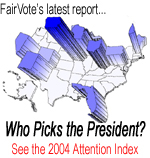 FairVote releases a new report Who Picks the President,
which chronicles the distribution of television ad spending and
political candidate visits during the height of the 2004 presidential
election. The report finds further evidence that a vast gulf has
developed between a handful of swing states that are zealously courted
by major political campaigns, and the rest of the country, which is
effectively shut out of the process.
FairVote releases a new report Who Picks the President,
which chronicles the distribution of television ad spending and
political candidate visits during the height of the 2004 presidential
election. The report finds further evidence that a vast gulf has
developed between a handful of swing states that are zealously courted
by major political campaigns, and the rest of the country, which is
effectively shut out of the process.