The
Center's long-time member Lee Mortimer of North Carolina has drafted
one possible alternative, using a version of limited voting that
approximates the Finnish election system. Limited voting already is
used in several North Carolina counties. Other options include
choice voting and cumulative voting. Common Cause of North Carolina
has endorsed this proposal.
Read Lee Mortimer's article in the May 30,
2001 Raleigh News & Observer that outlined this
proposal.
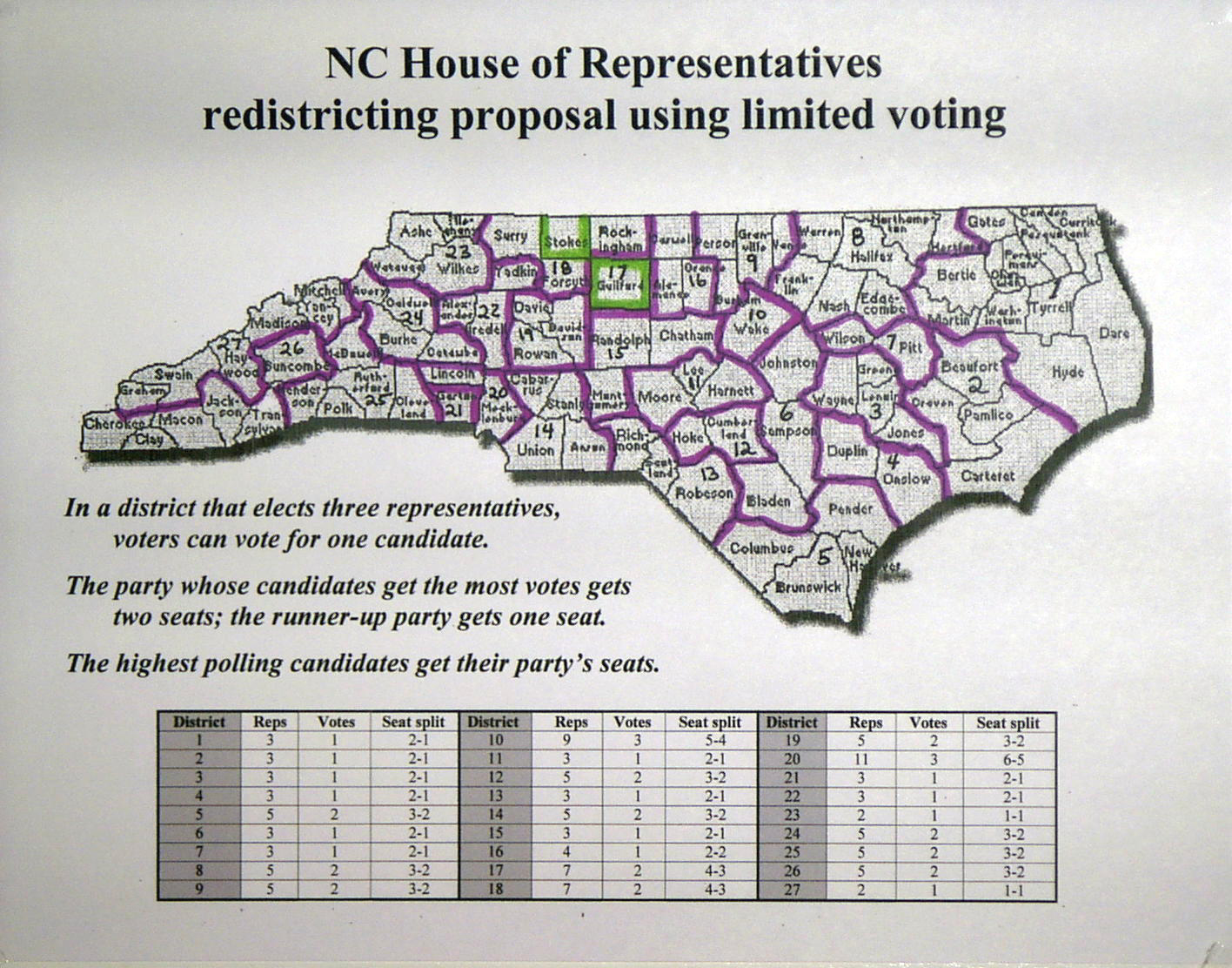
View maps of North Carolina House and Senate
multimember districts, proposed by Lee Mortimer. Under this
proposal, North Carolina would be divided into mostly 3- and
5-member districts with some larger districts to cover the state's
most populous counties. Under a "Finnish-style" limited voting
system, voters in 3-member districts would choose one candidate, the
party whose candidates receive the most votes would get two seats;
the runner-up party would get one seat. The highest polling
candidates get their party's seats.
In 5- and 7-member districts, voters could choose two
candidates and the seat split would be three or four seats for the
majority party and two or three seats for the minority party, and in
9- and 11-member districts, voters could choose three candidates and
the majority party would win either 5 or 6 seats in those
districts.
Though the plan includes some large multimember
districts, limited voting means voters would have the same number of
votes as now--one or two votes in Senate elections and one, two or
three votes in House elections. If an unaffiliated candidate
received more votes than a party winner, then that candidate would
win over the lowest polling party candidate. This method would
make elections more competitive, unlike many of the races in the
current system.
You can download Excel
spreadsheets containing demographic profiles of the proposed North Carolina House and Senate multi-member
districts. They also include
political analyses for these proposed districts. The 16
Senate and 27 House districts are listed by their component counties
with total population, white and non-white voting-age populations,
and the percentage of non-white VAP in each county and
district.
Based on the demographic composition of the districts
and by using an alternative voting method, more racial minorities
could be elected to the state legislature. Currently, people of
color represent 26 percent of North Carolina�s VAP but hold only 15
percent of legislative seats.
Returns from three statewide elections
in 2000 provide a profile of the partisan leanings of each of the
districts. By averaging the labor commissioner and two court of
appeals races across each county and district, the analysis shows
Democrats and Republicans would win an equal number of seats in the
state House and Senate. Forty percent of all legislative seats
are in districts that are competitive between Democrats and
Republicans.
One of the
concerns expressed about multimembers districts is the potential
costs of campaigning in larger districts. It turns out that
costs don't necessarily rise. You can read an important study about campaign
costs.
More on voting rights and alternative voting
systems.