











On
December 15, Iraq held its second ever proportional voting
election, designed to improve upon last January's constitutional
convention elections. This time, Iraq's
18 provinces (or governorates) elected members of parliament in
multi-member superdistricts using a proportional voting method.
Under the new system, 230 of 275 seats are allocated to each province
based on the province's population, and parties are awarded these
provincial seats in
direct proportion to their vote in each province. The 45 remaining
seats
are awarded to smaller parties that did not win seats in any given
province but nevertheless won a significant numbers of votes
nationally. The reforms are partly intended to better include
Sunni Muslims who, due to a boycott under the old system, won few
seats in January despite their proportion of Iraq's population. Early
indications suggest turnout was about 70 percent with exceptionally
high participation among Sunnis.
[ Full article on the FairVote Blog ]
[ FairVote's analysis of the January vote and successive reforms ]
[ IECI document on Iraq's electoral system - Adobe .pdf 77k ]
[ Explanation of apportionment and seat allocation - Adobe .pdf 278k ]
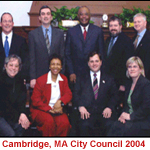 Choice
voting has been in use for City Council and School Committee elections
in Cambridge, Massachusetts since 1941. The city's proportional voting
system has consistently provided the city's African American population
with fair representation on the council, while encouraging a diversity
of political perspectives. This November, the Cambridge Election
Commission conducted yet another successful election using this fair
and effective electoral system, and both African American councilors
were re-elected in a city where that population makes up only 12% of
the
population. Notably, the ranked ballot feature of choice voting allowed
the two African American candidates to win on the 11th and final round
of counting with the crossover support of other defeated candidates.
Additionally, the electoral system made many of the races competitive,
insofar as one of the incumbents was defeated and after nine rounds of
elimination, only four of the nine candidates were elected. The
remaining five seats were filled with the support of the defeated
candidates' voters in the last two rounds of counting. Nevertheless,
the council is still a stable body, with eight of its nine members
returning in the next session. Similar results occurred for the School
Committee, where the African American incumbent was re-elected in the
fifth round, and two of six incumbents were defeated.
Choice
voting has been in use for City Council and School Committee elections
in Cambridge, Massachusetts since 1941. The city's proportional voting
system has consistently provided the city's African American population
with fair representation on the council, while encouraging a diversity
of political perspectives. This November, the Cambridge Election
Commission conducted yet another successful election using this fair
and effective electoral system, and both African American councilors
were re-elected in a city where that population makes up only 12% of
the
population. Notably, the ranked ballot feature of choice voting allowed
the two African American candidates to win on the 11th and final round
of counting with the crossover support of other defeated candidates.
Additionally, the electoral system made many of the races competitive,
insofar as one of the incumbents was defeated and after nine rounds of
elimination, only four of the nine candidates were elected. The
remaining five seats were filled with the support of the defeated
candidates' voters in the last two rounds of counting. Nevertheless,
the council is still a stable body, with eight of its nine members
returning in the next session. Similar results occurred for the School
Committee, where the African American incumbent was re-elected in the
fifth round, and two of six incumbents were defeated. This November, voters in California and Ohio soundly rejected ballot
measures calling for independent redistricting processes to be created
for each state's Congressional and state legislative line-drawing
processes. The failure of these efforts does not indicate voters
dislike reform, but it shows voters can be suspicious of plans that
promise more than they can achieve, as well as apparent partisan
motivations intrinsic to any mid-decade, state-by-state redistricting
initiative.
This November, voters in California and Ohio soundly rejected ballot
measures calling for independent redistricting processes to be created
for each state's Congressional and state legislative line-drawing
processes. The failure of these efforts does not indicate voters
dislike reform, but it shows voters can be suspicious of plans that
promise more than they can achieve, as well as apparent partisan
motivations intrinsic to any mid-decade, state-by-state redistricting
initiative.