










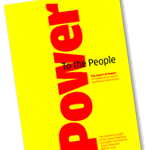
 Released early this month by an independent commission of ten UK citizens from all walks of life, Power to the People asks: why has engagement with "formal democracy" declined?
It's not apathy, news media, overwork, or a distractingly high standard of living. The causes: a new, more educated citizenry expecting to affect politics, blocked social mobility, a party system based on a bygone class structure and perception that the electoral system "wastes" votes.
The prescription: eighteen points relating to who governs Britain, how those bodies are chosen and who gets to choose them. Parallels with the American experience are striking.
[ Download summary and report ]
[ Power Inquiry home ]
[ Britain's Electoral Reform Society ]
 On March 2, FairVote and California Common Cause filed an amicus
brief to defend the California Voting Rights Act and argue that
proportional voting systems are sensible remedies in such cases.
Adopted in 2001, the California Voting Rights Act showcases how states
can protect voting rights even when Congress may weaken the federal
Voting Rights Act. Among other provisions, the Act allows plaintiffs to
challenge winner-take-all, at-large election systems when racially
polarized voting exists. The Lawyers Commitee for Civil Rights filed
such a challenge in Sanchez v. City of Modesto, but a judge struck down the Act.
On March 2, FairVote and California Common Cause filed an amicus
brief to defend the California Voting Rights Act and argue that
proportional voting systems are sensible remedies in such cases.
Adopted in 2001, the California Voting Rights Act showcases how states
can protect voting rights even when Congress may weaken the federal
Voting Rights Act. Among other provisions, the Act allows plaintiffs to
challenge winner-take-all, at-large election systems when racially
polarized voting exists. The Lawyers Commitee for Civil Rights filed
such a challenge in Sanchez v. City of Modesto, but a judge struck down the Act. As
the battles over partisan gerrymandering and re-redistricting move to
the Supreme Court, experts suggest that the court is unlikely to
dramatically change the status quo. As a result, efforts to reform the
system through the political process may become critical to ending the
partisan self-interest that has corrupted our line-drawing process.
As
the battles over partisan gerrymandering and re-redistricting move to
the Supreme Court, experts suggest that the court is unlikely to
dramatically change the status quo. As a result, efforts to reform the
system through the political process may become critical to ending the
partisan self-interest that has corrupted our line-drawing process.