The International Status of the Right to
VoteóDraft
Alexander Kirshner
Democracy Coalition Project[1]
Introduction
The right to vote is aone of the
well-established norms of international law.Ý Significant international covenants
treaties,
including the International Covenant on Civil and Political Rights and
regional agreements such as the American Convention on Human Rights, enshrine
citizensí claim to universal and equal suffrage. Regional human rights systems
in Europe and the Americas have effective mechanisms
to enforce the right to vote , thatwhich
have been applied in a limited fashion.
Ninety-seven97One hundred and eight out of the 119107 electoral
democracies surveyed constitutionally guarantee the right of their citizens to
elect their political representatives.[2]Ý In the last three decadesóa period of time
in which we have witnessed an astonishing increase in the number of politically
free statesóevery single new constitution has established a citizenís
entitlement to vote.Ý The language of
these constitutional directives fall along a broad spectrumóon one end are
those that simply establish the right of citizens to vote for constitutionally
defined electoral positions, on the other end are those constitutions which not
only guarantee universal suffrage, but also stipulate that that this
fundamental right exists at every level of government and/or curb the ability
of the government to reduce the size of the electorate.Ý
Every democratic state, however, restricts who can vote.[3]Ý Some constitutions delineate those who are
deemed ineligible for the franchise (the young, prisoners, the mentally
incapable, etc.), while
others identify the courts or the legislature as the branch of government
responsible for determining citizensí fitness to take part in elections. 42%Forty-twoThirty nine percent of
democratic constitutions which contain a right to vote grant legislatures the
power to determine those who are eligible.
Constitutional right to vote articles provide individuals a
powerful tool with which to challenge a state actions or state inaction that
impedes voters.
Yet, right to vote provisions are not a cure all.Ý The courts we examined have been careful to articulate that
legislatures have the right to constrict the pool of eligible voters and establish
rules which may limit the number of people who can vote. At the same time,
these cases illustrate the special characteristics of the right to vote.Ý Not only have courts viewed the right to
vote as a bulwark against government infringement (e.g., keeping certain
groups from voting), they have also seen the right to vote as imposing a
positive obligation on the state to ensure that people can vote (e.g., making special
efforts).
This paper provides a general overview of describes
the international status of the right to vote. Following this
summary, threewo
sections survey the guarantees to universal suffrage included in international
treaties and democratic constitutions.Ý
These sections also examine the language used to express the right to
vote.Ý The fourth fifth section
details the types of limitations that are commonly included in right to vote
provisions. The fifthsixth,
and final section, examines how right to vote provisions have been interpreted
by courts in three
jurisdictions . This sections surveys six cases from three courts
(two cases
each): the South African Constitutional Court, and the
Supreme Court of Canada, and the European Court of Human Rights.
Section 1: International
Declarations and Covenants
The affirmative obligation of states to protect their
citizensí right to vote is recognized inÝ
international
treaties and declarations adopted by documents establishing
the functions of bodies within the United Nations and by within
regional treaty organizations such as the Council of Europe and
the Organization of American StatesEuropean Convention and
the American Convention on Human Rights.Ý
The Universal
Declaration of Human Rights
The Universal Declaration of Human Rights (UDHR) is the
preeminent global aspirational document on human rights.Ý The declaration was adopted unanimously by
the United Nations General Assembly in 1948 and its aArticle 21 lays
out the right of people to participate in government and enjoy universal
suffrage:
The will
of the people shall be the basis of the authority of government; this will
shall be expressed in periodic and genuine elections which shall be by
universal and equal suffrage and shall be held by secret vote or by equivalent
free voting procedures. [4]
óhttp://www.un.org/Overview/rights.html
Because the declaration is a
non-binding treaty, itís
provisions are not accepted in toto
as international law.Ý Some of the
provisions of the UDHR are considered to have the status of binding
international law by virtue of their becoming components of international
customary lawólaw which ìrefers to the conduct, or the conscious abstention
from certain states that becomes in some measure a part of the international
legal order.î[5] Article 21,
however, has not been
accepted as come a component of
generally enforceable customary international law.[6]Ý
The International
Covenant on Civil and Political Rights
In contrast to the UDHR, Article 25 of the International
Covenant on Civil and Political Rights (ICCPR) takes its binding effect from
its ratification by
a large number of its signatories (150 to date). The
Human Rights Committee (HRC), a permanent treaty organ, was created by the
ICCPR.Ý The practical role of the HRC is
not enforcement, nor deterrence, nor dispute-resolution. Rather it monitors,
studies, and reports on measures taken to give effect to the Covenant and
interprets and clarifies the meaning of the covenant through consideration of
ìcommunicationsî from individuals claiming to be victims of violations of the
covenant.[7]Ý Article 25 states:
Every
citizen shall have the right and the opportunity, without any of the
distinctions mentioned in article 2 and without unreasonable restrictions: (a)
To take part in the conduct of public affairs, directly or through freely
chosen representatives; (b) To vote and to be elected at genuine periodic
elections which shall be by universal and equal suffrage and shall be held by
secret ballot, guaranteeing the free expression of the will of the electors.[8]
ó
http://www.unhchr.ch/html/menu3/b/a_ccpr.htm
The text of this article closely tracks the language of aArticle 21 of the
UDHR.Ý One important distinction,
however, bears noting: the covenant specifies that only citizens shall have the
right to vote.Ý Though in most cases
limiting the electorate to citizens is legitimate, restrictive citizenship
rules can be used as a backdoor method of disenfranchising large swaths of
adults on the basis of attributes such as ethnicity and first language. In
addition, according to the Committee, the covenant not only protects the right
of every citizen to vote, but also requires states to take the measures
necessary to ensure that citizens have an effective opportunity to enjoy the
rightóin particular the Committee has emphasized that the right to vote ought
to be guaranteed by law.[9]
Section 2: Regional
ConventionsÝ
The European
Convention on Human Rights and Fundamental Freedoms
The European Convention on Human Rights and Fundamental
Freedomsówhich was established by the members of the European CommunityCouncil of Europe in
1950 [I
thought it was Council of Europe?]óis distinguished by its
active international courtCourt and its effective complaints procedure
for the determination of human rights matters.Ý
Currently, the courtCourt is the ultimate authority on human
rights for the citizens of 41 member statesóthus the courtCourt has
jurisdiction over 800 million people.[10]ÝÝ Because the Cconvention has
an effective enforcement mechanism, it is the leading human rightsóand thus
voting rightsóstatute within the intra-European system.
In terms of the right to vote, the courtCourt enforces
Article 3 of Protocol 1 (P1-3P3-1) of the European Convention, which
states:
The High Contracting Parties undertake to
hold free elections at reasonable intervals by secret ballot, under conditions
which will ensure the free expression of the opinion of the people in the
choice of the legislature.
It has been claimed that the Article (P1-3P3-1) does not give
rise to individual rights and freedoms.ÝÝ
Through its willingness to accept cases brought by individuals and in
its judgments, the courtCourt, however, has underscored that the
right to vote iswas
enjoyed by individuals. The courtCourt ruled, in the case of Mathieu-Mohin and Clerfayt v. Belgium ,
that the particular language of P1-3P3-1this article was
not intended to exclude the right of the individual to vote, but:
to give
greater solemnity to the commitment undertaken and in the fact that the primary
obligation in the field concerned is not one of abstention or non-interference,
as with the majority of the civil and political rights, but one of adoption by
the State of positive measures to ìholdî democratic elections.[11]
In practice, the courtCourt takes
relatively few cases regarding this article (section two of this paper will
discuss two of these cases). Two interrelated factors contribute to the courtCourtís relative
inactivity on matters of suffrage: first, the courtCourt insists that
domestic remedies be exhausted before it takes up a case and the courtCourt provides states
leeway to resolve issues on their own; second, because a ìgenuineî democracticdemocratic system is
a prerequisite of membership in the Council, the courtCourt has found
comparatively few cases where domestic remedies to suffrage disputes have
appeared inadequate.ÝÝ
In addition to the CCconvention[I forget the rule, but just be consistent re caps, I prefer them],
intra-Europeísan
commitment to the right to vote is affirmed by documents and regulations of the
Organisation for Security and Cooperation in Europe and the European Union. Not
surprisingly, the right to vote and universal suffrage have been also been
incorporated into the new draft constitution being negotiated forof the
European Union.
Organization of
American States (OAS)
With
the spread of
elected civilian governments during the 1980s Since
its inception in 1948, the Organization of American States (OAS) has become
increasingly aggressive active in
promoting representative democracy and the right to vote.Ý Membersí efforts to strengthen the OASís
mandate in this area culminated in 2001, when the OAS adopted the
Inter-American Democratic Charter.Ý This
Charter, a
political document adopted by the 34 member states, states that emphasizes
thethe
peoplesí of the Americas have a ìright to
democracyî and establishes that a fundamental element of democracy is ìthe
holding of periodic free and fair elections based on secret balloting and
universal suffrage.î[12]Ý More importantly, the Charter creates a
mechanism for a collective response to an unconstitutional interruption of the
democratic order of a member state.Ý The
Charter empowers the OAS General Assembly to suspend the membership of the
member state in question when there has been an ìunconstitutional
alterationî of the democratic legal order. The Charter also includes
provisions set out a responsibility for the OAS
to observe elections in member states.[13]
The lead role in protecting the right to vote in
the inter-American system is not played by a Inter-American Human Rights
Courtówhich generally handles cases related to disappearances or murdersóbut by
the Inter-American Commission on Human Rights.Ý
This Commission is empowered to accept individual cases and prepare
country reports for which it can conduct onsite investigations.Ý In the early 1990ís, the Commission authored
reports on violations of the right of political participation in Mexican
elections and the progress of the Mexican government in addressing these
infringements.[14]
In
addition to the Charter, OAS member states have created an inter-American human
rights system through
adoption of The motivating document behind both the Court and
the Commission is the American Convention on Human Rights, which has been
ratified by 25 of the 35 members of the OAS.[15]Ý The Convention establishes an Inter-American Court on Human Rights, based
in Costa Rica, and an Inter-American Commission on Human Rights, based in
Washington.Ý In most respects, the voting rights language
of the American Convention tracks with the language of the ICCPR.Ý The American Convention, however, delineates
broad categories along which a member state may limit the right to vote.
Article 23 of the Cconvention
states that:
1. Every
citizen shall enjoy the following rights and opportunities: a. to take part in
the conduct of public affairs, directly or through freely chosen
representatives; b. to vote and to be elected in genuine periodic elections,
which shall be by universal and equal suffrage and by secret ballot that
guarantees the free expression of the will of the voters; andÖ
2. The law
may regulate the exercise of the rights and opportunities referred to in the
preceding paragraph only on the basis of age, nationality, residence, language,
education, civil and mental capacity, or sentencing by a competent court in
criminal proceedings.
In addition to the Convention, the member states of the OAS
have also adopted an aspirational document
endorsing the right to vote: The American Declaration of the Rights and Duties
of Man (1949).Ý The American Declaration
establishes the right to vote, and, in contrast to other prominent human rights
documents, it also includes a duty to vote in the country in which one is a
citizen.[16]Ý
The lead role in
protecting the right to vote in the inter-American system is not played by the Inter-American Human Rights
Courtówhich generally handles cases related to disappearances or murdersóbut by
the Inter-American Commission on Human Rights.Ý
This Commission is empowered to accept individual cases and prepare
country reports for which it can conduct on-site investigations.Ý In the early 1990ís, the Commission authored reports on
violations of the right of political participation in Mexican elections and the
progress of the Mexican government in addressing these infringements.[17]
Section 3: The Right to Vote in Democratic Constitutions
The opportunity for citizens to participate in politics is established by a variety of means.Ý Though over 90% of the worldís electoral democracies have included the right to vote in their constitutions, it has been articulated in a number of different ways or not at all.Ý For example, there is no constitutional right to vote in two of the worldís oldest democracies, the United Kingdom and the United States of America, nor in the worldís most populous democracy, India.Ý Yet, as Bush v. Gore demonstrated, the existence of a constitutional right to vote and the language used to express it can have significant ramifications on the manner in which the state protects and promotes citizensí right to vote.Ý
Constitutions break into four categories depending on how they treat the right to vote:
1. Those in which there is no affirmative constitutional right to vote or no legislation with similar weight.
2. Those that establish universal suffrage for the election of sovereign bodiesósuch as a parliament.
3. Those that provide a general and independent right to vote.
4. Those that not only provide for a right to vote, but also specify government obligations to facilitate citizen participation and/or those that limit the kinds of restrictions the state can place on who is eligible to vote.
While this typology is not scientific, the categories are
coherent and reflect the ways universal suffrage is constitutionally
enshrined.Ý Neither are the categories
exclusiveóif a countryís constitution requires that representatives to
parliament should be elected according to universal suffrage, but also provides
a general article guaranteeing universal suffrage, then this countriesí
constitution is placed in group 3.Ý In
what follows, the paper provides a numerical breakdown along these categories
and offers examples of the constitutional language they represent.
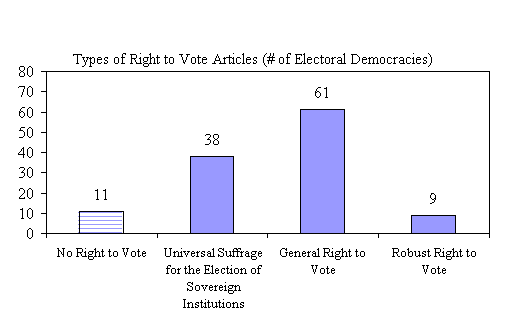
No Right to Vote:
ElevenTen
democracies have no explicit constitutional right to vote.Ý Until they established their own
constitutions, all of these countries but one were ruled by the Parliament of the
United Kingdom or were territories of a country that was.[18]
ÝThe exception is Indonesia.Ý Paradigmatic examples are the United Kingdom
where there is no written constitution, and the United States.Ý
Universal Suffrage for
the Election of Sovereign Institutions
In many constitutions, the right to vote is not expressed as an individual right, but universal suffrage and secret elections are mandated for the fulfillment of positions in sovereign bodies, such as a legislature.Ý The South Korean constitution is representative of these types of constitutions.
Article 41: The National Assembly is composed of
members elected by universal, equal, direct, and secret ballot by the citizens.
Article 67: The President is elected by universal,
equal, direct, and secret ballot by the people.[19]
For these states, the existence of a right to vote for representatives in institutions other than those specifiedófor example state or local governmentóis left to the legal interpretative structure of that country.
General Right to Vote
A stand-alone right to vote is the international standard in
democratic constitutions.Ý A clear
majority of the worldís democratic constitutions have articles or clauses
outlining citizensí entitlement to choose their representatives at all levels
of government.Ý Most of these
constitutions have sections similar to Article 49 of the constitution of
Portugal, which states:
All citizens who are over 18 years of age have the
right to vote, except for the incapacities laid down in general law. The
exercise of the right to vote is personal and constitutes a civic duty.[20]
By contrast, oOther
constitutions within this group specify that the tenets of universal suffrage
should be extended to all elected positions. Bulgariaís constitution
exemplifies such statutes.
Article 10: All elections and national and local
referendums shall be held on the basis of universal, equal, and direct suffrage
by secret ballot.
Article 42: Every citizen above the age of 18, with
the exception of those placed under judicial interdiction or serving a prison
sentence, is free to elect state and local authorities and vote in referendums.[21]
Robust Right to Vote
Provisions
Some constitutions go beyond asserting a right to vote by explicitly curbing the stateís power to limit those who are eligible to vote.Ý An example of this is Article 32 of the Peruvian Constitution.Ý While the Peruvian constitution allows the suspension of the rights of citizenshipóand thus the right to voteóit also constructs additional barriers against the winnowing of those eligible to vote.Ý Article 32 states that:
Citizens enjoying their civil capacity have the right to vote. The vote
is personal, equal, free, secret and obligatory until one is seventy years
old.Ý It is optional after this age. All
acts that limit or prohibit citizens from exercising their rights are null and
punishable.[22]
Other constitutions, like that of Suriname, not only attempt to establish tests on the types of restrictions considered constitutional, but also establish the affirmative obligation of the state to promote electoral participation:
Article
54:Ý The State is obliged to register
those with voting rights and to convoke them to participate in the elections.
The registration of the voters shall serve no other purpose. Those with a right
to vote are obliged to cooperate with the registration of the electorate.[23]
Constitutions which
Incorporate International Human Rights Conventions
In addition to the type of guarantees just described, a number of Latin American and Eastern European constitutions such as Chile, Ecuador, the Czech Republic and Slovakia, grant ratified international human rights covenants constitutional or greater status in domestic law.Ý As elaborated in the previous sections, the predominant international and regional human rights documents all establish a right to vote.Ý Article 10 of the Czech constitution is indicative of the type of constitutions in which the right to vote is buttressed by a commitment to international norms:
Promulgated
international agreements, the ratification of which has been approved by the
Parliament and which are binding on the Czech Republic, shall constitute a part
of the legal order; should an international agreement make provision contrary
to a law, the international agreement shall be applied.[24]
ó http://www.psp.cz/cgi-bin/eng/docs/laws/constitution.html,
10/28/03
This type of constitutional clause, which is becoming more common, demonstrates the trend towards the acceptance of international standards of human rightsóand thus the right to voteóas a standard component of domestic law.
Section 4: Limitations on
the Right to Vote
The right to vote
necessarily entails limitations on who can exercise that right. It is not
uncommon for the limits to be embedded in the constitutions of electoral
democracies. Beyond the paradigmatic examples of citizenship and age limits,
constitutions often explicitly withhold the right to participate in elections
from those who are deemed mentally incapable and/or from prisoners. The types
of restrictions governments place on the right to vote fall into three general
categories:
1)
Restrictions
based on community membership
‚
Examples: citizenship,
residence, language
2)
Restrictions
based on competence or autonomy
‚
Examples: age, mental
health
3)
Restrictions
as a form of punishment
‚
Examples: imprisonment,
voter fraud, treason
All three forms are evident
in the constitutions of the worldís electoral democracies. For example, Section
110 of the Thai constitution states:
A person under any of the
following prohibitions on election-day is disfranchised:
1)
being of unsound mind or of
mental infirmity;
2)
being a Buddhist priest,
novice, monk or clergy;
3)
being detained by a warrant
of the Court;
4)
being disfranchised by a
judgment.[25]
In addition to
constitutional restrictions on the right to vote, almost forty percent of the
constitutions surveyed allow for restrictions of universal suffrage to be
determined through laws approvedÝ by the
legislature.Ý In general, a restriction
established by a legislative act must still meet certain constitutional
standards, e.g., be non-discriminatory in intent. Similarly, legislatures
working under constitutions that do not explicitly permit them to limit the
electorate, generally must follow a common constitutional guideline for
regulating the rights established in the constitution. For example, the
Canadian Charter of Human Rights and Freedoms stipulates that any of the rights
and freedoms it sets out are ìsubject only to such reasonable limits prescribed
by law as can be demonstrably justified in a free and democratic society.î[26]Ý Thus, the Canadian parliament must meet this
standard to restrict suffrage.Ý
Finally, the court cases
examined in the following section illustrate that the electorate is often
reduced by electoral regulation, rather than by overt constitutional
limitations. As is borne out by the two South African cases, the distinction
between whether a lawís intent is regulatory or exclusionary can have important
ramifications on the level of scrutiny that high courts apply to that law.ÝÝ
Section 5: Right to Vote Court Cases
The following section
examines six rulings of three high courts: the Supreme Court of Canada, the
Constitutional Court of South Africa, and the European Court for Human
Rights.Ý This brief survey is intended
to provide insight into how these courts have interpreted the right to vote.
Three broad conclusions stand out from this work:
…
The Courts occupied different positions with
respect to the deference owed to those responsible for regulating elections.
‚
The Canadian Court was the
least deferential, and in the two cases examined, it was the most active in
protecting and expanding citizensí right to vote.
‚
The South African court was
skeptical of an administrative restriction of the right to vote, but gave a
broader margin to the legislature to make rules concerning elections.
‚
The European Court was the
most deferential of the three courts.Ý
Its deference is almost certainly a product of the fact that it hears
cases concerning a wide variety of dissimilar, but still legitimate electoral
systems.Ý This trend may be indicative
of how other international courts would interpret a right to vote statute which
applies across a number of states.ÝÝ
…
A key issue common to most of these cases was where
the balance should be struck between regulations that ensure a free and fair
election and the right of all citizensí to vote.
…
Unless specified, a right to vote does not
necessarily entail that each vote will have equal weight in the determination
of electoral outcomes.
Canada
Section 3 of the Canadian
Charter of Rights and Freedoms states that ì[e]very citizen of Canada has the
right to vote in an election of members of the House of Commons or of a
legislative assembly and to be qualified for membership therein.î[27]Ý In the two cases examined hereóSauve v. Canada and Figueroa v. Canadaóthe Supreme Court of Canada explored the
governmentís ability to limit the right to vote and fleshed out the content of
the protection which the right to vote extends to electoral practice.Ý The two cases examined were heard in the
recent pastó2003 and 2002, respectively.Ý
In both cases, the Court subjected the governmentsí efforts to regulate
the right to vote to vigorous scrutiny and enhanced the protections entailed by
the right to vote.Ý In Sauve, the Court determined that
prisonersí right to vote cannot be bluntly abrogated, and in Figueroaówhich dealt with the regulation
of political partiesóthe Court concluded that Section of 3 of the Charter
extends beyond the act of voting and guarantees individuals the right to play a
meaningful role in the electoral process.
Sauve v. Canada (2003)
In Sauve, the Supreme Court struck downÝ Section 51(e) of the Canada Elections Act, which denied the right
to vote to all inmates serving sentences of two years or more, as an
unconstitutional infringement of the right to vote.Ý The existence of an affirmative right to vote in the Canadian
Charter of Rights and Freedom, however, had another striking impact on the
course of the case.Ý Rather than the
petitioner having sole responsibility to demonstrate the unconstitutionality of
the Act, it fell to the government to demonstrate the constitutional validity
of its actions.
Ý
Before proceeding to the
merits of the case, the Court considered whether it should defer to the will of
the Parliament.Ý The government and the
dissenting opinion argued that debate over the legitimacy of denying the right
to vote to penitentiary inmates was a matter of social and political
philosophy.ÝÝ In such debates, they
asserted, the Court owed deference to the political branch of government. The
dissent stated that:
The decision before this Court is therefore not
whether Parliament has made a proper policy decision, but whether or not the
policy position chosen is an acceptable choice amongst those permitted under
the Charter.[28]
To emphasize this position,
the dissent noted the variety of policies concerning prisonersí right to vote
allowed by foreign courts interpreting their own democratic constitutions and
treaties which guaranteed the right to vote.ÝÝ
The majority rejected this line of reasoning.Ý It held that the right to voteís status as a ìfundamentalî or
ìcore democraticî right necessitated that attempts to limit it be met with
ìcareful examination,î not with judicial deference.[29]
The Court emphasized that:
[I]t is precisely when legislative choices threaten
to undermine the foundations of participatory democracy guaranteed by the
Charter that courts must be vigilant in fulfilling their constitutional duty to
protect the integrity of the system. [30]
Canadaís Charter
establishes two questions for consideration in cases regarding the rights
enshrined within it: first, whether a right has been infringed, and second,
whether the limitation was justified.Ý
In Sauve, the Court focused on
whether the limitation was justified and, in particular, whether the
restrictions were reasonable.
The Court focused on the
reasonableness of the statute because the government conceded that it had
impinged on the Charter.Ý To justify
this type of limitation the statute had to pass a double pronged test: first, the
government had to show that the infringement achieved a constitutionally valid
objective, and second, that its chosen means were reasonable. The government
argued that it had two broad objectives in restricting a class of prisoners
from voting: ì(1) to enhance civic responsibility and respect for the rule of
law; and (2) to provide additional punishment, or ëenhance the general purposes
of the criminal sanction.íî[31]
Though skeptical of the constitutionality of such ì[v]ague and symbolic
objectives,î the Court concluded that these aims couldóinÝ theoryóbeÝ
advanced as suitable objectives for the Government to restrict
fundamental rights.Ý Accordingly, the
Court moved on to consider the reasonableness of the limitations.
The majority held that the
limitations imposed by the government did not advance the governmentís stated
aims (rational connection test), that the denial went further than reasonably
necessary to achieve its objective (the minimal impairment test), and that the
overall benefits of the measure did not outweigh its negative impacts (the
proportionate effect test).[32]Ý With regard to a rational connection between
the means and the aims of the Government, the Court rejectedówhat it considered
to be a premise of the governmentís argumentóthat: ìvoting is a privilege that
the government can suspend.î[33]Ý The Court held:
[t]he right of all citizens to vote, regardless of
virtue or mental ability or other distinguishing features underpins the
legitimacy of Canadian democracy and Parliamentís claim to power.Ý A government that restricts the franchise to
a select portion of citizens is a government that weakens its ability to
function as the legitimate representative of the excluded citizen, jeopardizes
its claim to representative democracy, and erodes the basis of its right to
convict and punish lawbreakers. [34]
Removing the right to vote
from prisoners would not augment the value society placed on the vote, or
deepen criminal penalties, but would rather further undermine societyís respect
for the right to vote and felonsí connection to society.Ý The Court distinguished between youth
restrictions (e.g. to vote one must be 18) and restrictions on prisoners. In
the first case, Parliament was making a universal distinction based on
experience; in the second, ìit was making a decision that some people, whatever
their abilities, are not morally worthy to voteóthat they do not ëdeserveí to
be considered members of the community.î[35]
In addition, because the act was neither tailored to the acts, nor the
circumstances of the individual offender, the Court held that the lawís retributive and denunciatory
effects were arbitrary in effect. Thus, it rejected the governmentís case on
the basis of its failure to satisfy the rational connection test.Ý
Because the Court held that
the punishment was not rationally connected to the aim, it did not follow into
great depth either the minimal impairment or proportional effect tests.Ý It did note, however, that because of the
arbitrariness of the law, it was likely to fail these tests, as well.Ý Finally, it bears noting that the Court was particularly concerned
with the disproportionate impact the law would have on the disadvantaged
Aboriginal population, who are overrepresented in the Canadian prison system.[36]
Figueroa v. Canada
The judgment in Figueroa
v. Canada is of particular interest because the Court held that the laws
and policies of the government must meet the explicit standard established in
Section 3 and the standard established by its purpose.Ý A significant portion of the judgment in Figueroa was devoted to defining the
purpose of Section 3óthe right to vote sectionóof the Canadian charter. The
purpose was established as ìthe right of each citizen to play a meaningful role
in the electoral process, whatever the process might be.î[37]
At issue in this appeal was
the requirement that a political party nominate candidates in at least 50
electoral districts to obtain and then to retain, registered party status.Ý Registered party status entailed both
obligations and benefits.Ý In Figueroa, the Court only considered:
ìthe right of a political party to issue tax receipts for donations received
outside the election period, the right of a candidate to transfer unspent
election funds to the party (rather than remitting them to the government), and
the right of a partyís candidates to list their party affiliation on the ballot
papers.î[38] The
majority set itself two tasks in determining whether the 50-candidate threshold
violated S.3. : first, to define the purpose of Section 3 and, second, to
evaluate whether the 50-candidate threshold abrogated that purpose. The
majority found that the threshold did violate the charter.Ý Thus, it also had to determine whether the
violation was justified.Ý The Court
found that the threshold was not constitutionally justified.
While establishing the
purpose of Section 3, the Court noted that as the section is written, it is
relatively narrow in granting citizens no more than the ìbare right to vote and
to run for office in the election of representatives of the federal and
provincial legislative assemblies.î[39]Ý But Charter analysis, the Court argued,
requires courts look beyond the words of the section to its scope. To determine
the scope, ìcourts must adopt a broad and purposive approach that seeks to
ensure that duly enacted legislation is in harmony with the purposes of the
Charterî[40] The
majority referred to a previous case, Haig
v. Canada [1993], in which the Court held that:
the purpose of s. 3 of the Charter is not equality
of voting power per se, but the right to ìeffective representation.î Ours is a
representative democracy.Ý Each citizen
is entitled to be represented in government. Representation comprehends the
idea of having a voice in the deliberations of government as well as the idea
of the right to bring oneís grievances and concerns to the attention of oneís
government representative.ÝÝÝ
In Figueroa, ìeffective representationî was interpreted to mean more
than a right to effective representation in a legislative assembly, but also a
right to participate.Ý The right to
vote, the Court held, had an intrinsic
value independent of the outcome of elections. [are those words yours or can
they be fairly imputed to the Court?] Effectively the Court expanded the
protection of the Constitution to include a right to ìeffective
representationîówhichÝÝ constituted, in
effect, the right to play a ìmeaningful roleî in the selection of elected
representatives.[41]
The dissent distinguished
between the issues at stake in Sauveóa
case involving a literal prohibition of the Charteróand those at stake in Figueroaóa case dealing with legislation
that affects the conditions under which the citizens vote or run for an
election.[42]Ý The majority held, however, that the only
difference was that in considering questions about electoral conditions, the
Court had to examine the broader social or political context of the
legislation.[43] Further,
the Court rejected the argument that the collective interest in the aggregation
of political preferences ought to be balanced against the individual right to
meaningful political participation.Ý
Collective interests advanced by the electoral system did not rise to
the level of constitutional status.[44]
Ý
Having determined the
purpose of Section 3, the Court held that the 50-candidate threshold interfered
with the right of citizens to play a meaningful role in the electoral
process.Ý To come to this determination
the Court answered two questions.Ý
First, do the members and supporters of small political parties play a
meaningful role in the electoral process? And, if so, do the restrictions
contained in the law infringe on their ability to play that role? In terms of
the first question the Court ruled that political partyís ability to make a
valuable contribution to the electoral process was not limited to its capacity
to offer a genuine governmental option.Ý
Rather, political parties were held to enhance the meaningfulness of
individual participation.Ý The Court emphasized that parties
were especially important in ensuring that the ideas and opinions of their
members and supporters were effectively represented.[45]Ý
As to the second question,
the Majority distinguished between restrictions that impacted all political
partiesówhich might withstand constitutional attentionóandÝ those that ìbestow a benefit upon some
political parties, but not othersîówhich require scrutiny.[46]Ý The Court saw the legislation under consideration falling
into the second category and judged it to be unable to withstand constitutional
scrutiny.Ý Accordingly, the Court held that
each of the three restrictions under consideration restricted the ability of
parties to facilitate meaningful participation by individuals.Ý
Finally, as in Sauve, the Court had to consider whether
the limitation was reasonable and demonstrably justifiable in a free and
democratic society.Ý The government
offered three goals to defend the limitation of Section 3: first, ìto improve
the effectiveness of the electoral process;î second, ìto protect the integrity
of the electoral financing regime;î and, third, ìto ensure that the process is
able to deliver a viable outcome for our form of responsible government.î[47]
The Court was skeptical of all of these claims and ultimately ruled that
ì[l]egislation that violates Section 3 for [these purposes] does great harm to
both individual participants and the integrity of the electoral processÖ[given
the governmentís claims] it is impossible to conclude that the legislation is
justifiable in a free and democratic society.î[48]
South Africa
Within the span of two weeks
in 1999, the Constitutional Court of South Africa handed down two critical
decisions interpreting the meaning of the right to vote in South Africa: August and Another v. Electoral Commission
and Others; and New National Party of
South Africa v. Government of the RSA and Others.Ý Both decisionsóauthored by Justices Sachs and Yacoob,
respectivelyóstruggle with the particular challenges posed by the
interpretation of a relatively new constitution adopted by a nation with a
still-palpable legacy of oppression.Ý
Because the cases revolved around a constitutional right to vote, and in
the South African system the Constitutional Court is empowered to rule on the constitutionality
of legislative acts some of the cases were heard prospectively (.i.e. before
the elections). ÝThe South African constitution grants the Court the authority to judge the
constitutionality of Acts of Parliament.Ý Such
cases can be directly brought to the Court by the President, or a Member of Parliament, or cases
can be referred to the Court by high courts which have been petitioned by any person.[49] ÝIn August, the Courtís judgment effectively
expanded the electorateóthe Court ruled that in the absence of legislation
excluding imprisoned citizens from the electorate, the Electoral Commission
(the commission) had a reasonable obligation to insure that prisoners had the
opportunity to vote. The Court stated ìthe right to vote by its very nature
imposed positive obligations upon the legislature and the executiveÖ.Rights may
not be limited without justification and legislation dealing with the franchise
must be interpreted in favour of enfranchisement rather than
disenfranchisement.î[50]
In New National Party, the Court considered a requirementóestablished by
parliamentary legislationóthat voters present a particular form of
identification in order to vote.Ý Though
the requirement was likely to disenfranchise a significant portion of the
eligible population, the Court ruled that it was constitutional.Ý Legislation regulating an election, the
majority held, need only be rationally connected to a legitimate governmental
purpose to be constitutional. [51] ÝAccordingly, the restrictive, but rational requirement was upheld.
Examined together, these two rulings demonstrate that in the case of South
Africa, while the right to vote places a substantial onus on government
agencies to protect and facilitate citizens voting, the legislature still
commands a broad area of authority within which to regulateóand even limitóthe
electorate.
August and Another v. Electoral Commission and
Others
August concerned two applicants: the first, a sentenced
prisoner convicted of fraud; the second, a prisoner awaiting trial for
fraud.Ý They had approached the
commission to ensure that theyóand all other prisonersówould be allowed to
register as voters on the national voting rolls and to vote in general
elections.Ý The chief electoral officer
of the commission responded that the commission had made no arrangements to
allow prisoners to vote in the forthcoming election.
The 1996 constitution of
the Republic of South Africa provides that one of the principles on which the
state is founded is ì[U]niversal adult suffrageî and ìa national common voters
roll.î It guarantees that ì[e]very adult citizen has the rightÖto vote in elections
for any legislative body established in terms of the Constitution, and to do so
in secret.î[52]ÝÝ The Constitution contains no explicit
provisions allowing for laws which disqualify citizens from voting.Ý Thus, if Parliament seeks to limit the
franchise it must meet the tests applied to all prospective changes to the Bill
of Rights.Ý Such modifications must be
generally applicable and reasonable, and justified in a society based on human
dignity, equality and freedom.[53]Ý As of 1999, Parliament had not limited the
right to vote of prisoners.Ý The 1998
Electoral Act specified that South African citizens needed to apply for
registration ìonly for the voting district in which that person is ordinarily resident [my emphasis].î In addition, the Act detailed the special
obligations of the commission with regard to persons who find it impossible to
appear in person at voting stations.ÝÝ
Neither the Constitution, nor the 1998 Electoral Act expressly mentioned
the voting status of prisoners.
The petitionersí case was
initially considered by the Transvaal Provincial Division of the High
Court.Ý The Transvaal court ruled that
under the Constitution prisoners did have the right to vote.Ý The Court held, however, that:
[i]f a person does something which deprives him or her
of the opportunity to vote the [commission]Öcannot be held responsible. An
example is a person who specifically decides not to register because he does
not want to vote, also a person who is on vacation and decides not to return to
his ordinary place of residence for the purpose of voting. The predicament in
which the first and second applicants and all other prisoners, sentenced and
unsentenced, find themselves, is of their own making.Ý They have deprived themselves of the opportunity to register and
or to vote.
The Transvaal courtónoting
the logistical difficulty and expense of allowing prisoners to voteóargued that
special measures should only be made to accommodate voters whose predicament
was not of their own making.[54]
The Constitutional Court
overturned this ruling.Ý It based its
decision on the fundamental importance of the right to vote.Ý The Court found that prisoners should not be
deprivedódirectly or indirectlyóof personal rights which had not been taken
away by law.ÝÝ The Court held that:
[u]niversal adult suffrage on a common voter roll is one of the foundational
values of our entire constitutional order.Ý
The achievement of the franchise has historically been important both
for the acquisition of the rights of full and effective citizenship by all
South African regardless of race, and for the accomplishment of an all
embracing nationhood.Ý The universality
of the franchise is important not only for nationhood and democracy.Ý The vote of each and every citizen is a
badge of dignity and personhood.Ý Quite
literally, it says that everybody counts.Ý
In a country of great disparities of wealth and power it declares that
whoever we are, whether rich or poor, exalted or disgraced, we all belong to
the same democratic South African nation; that our destinies are intertwined in
a single interactive polity.Ý Rights may
not be limited without justification and legislation dealing with the franchise
must be interpreted in favour of enfranchisement rather than disenfranchisement.
[55]
Whether prisoners retained
the right to vote was not in dispute in this case. Whether they could exercise
it was disputed.Ý To reach its verdict,
the majority relied on ruling on a similar question by the US Supreme Court. In OíBrien v. Skinner, the US Supreme Court ruled that prisonersí
votes were of the same weight as others. Special consideration should be given
to them as with any other citizen who finds it impossible to appear in person
at voting stations.Ý ìParliament cannot
by its silenceî the US Court held, ìdeprive any prisoners of the right to
vote.Ý Nor can its silence be
interpreted to empower or require the Commission or this Court to decide which
categories of prisoner, if any, should be deprived of the vote.î[56]ÝÝ The South African Court rejected the argument that allowing
prisoners to vote posed special hardships on the commission. The commissionís
intention to make no effort to allow prisoners to vote amounted to an
unconstitutional deprivation of their right to vote.
New National Party of South Africa v Government of
the RSA and Others
The Constitutional Courtís
ruling in New National Party explored
the tension between reasonable regulation of elections and the sanctity of
universal suffrage. Twelve days after ruling on August, the Court released its determination on the
constitutionality of an electoral regulationóestablished by Parliamentóthat
appeared likely to disenfranchise up to 10% of eligible voters.[57]Ý Parliament required voters to have an identity card with a bar-
coded identification number.Ý The applicant
sought for this regulation to be deemed unconstitutional on the grounds that it
contravened citizensí right to vote.
The appellantóthe New
National Party of South Africaóargued that this requirement was
unconstitutional because Parliament had not established an effective mechanism
for ensuring that all citizens would be able to vote.Ý At the time of the Court ruling one in en members of the electorate did not hold one of these cards.Ý Many of those who had not applied for the card were not aware of
the need to have it. A disproportionate number of the disenfranchised hailed
from rural areas. Half of these people held other forms of
identificationórecognized by the state with regard to other mattersóbut would
still not be allowed to vote. Further, the Commission had informed Parliament
that the government would be hard pressed to produce enough new identification
cards in time for the election.[58]ÝÝ
The majority held that New National Party fundamentally
differed from August because ìthe
alleged disenfranchisement is said to arise from the terms of the statute and
not from the acts or omissions of the agency charged with implementing the
statute.î[59]Ý Accordingly, the Court ruled that it was
Parliamentís responsibility to insure that a measure was a reasonable and it
was the Courtís responsibility to determine whether an act was ìrationally connected to a legitimate
government purpose [my italics].î[60]Ý The act was deemed rational because the
regulation of elections gives content to the right to vote.Ý Though some might be disenfranchised, id
cards with a barcode served a particular rational purpose: they made it easier
for election workers to determine who voted and provide a standard mode of
identification.
In addition to the
rationality of the statute, the majority held that Parliamentís legislation
must not infringe on fundamental rights enshrined in the constitution.Ý The juridical test determined to be
appropriate for this question was to examine whether Parliament had insured
that people who would otherwise be eligible to vote were able to do so if they
wanted to vote and if they took reasonable steps in pursuit of the right to
vote.[61]
The Court ruled that Parliament met this test through the provisions it made to
make voters aware of requirement and to provide them with idís.Ý As the regulation was not on its face
discriminatoryóthought it arguably was in effectóthe Court upheld the regulation.
In her dissenting opinion
in New National Party, Justice
OíRegan applied the logic contained in August
to determine the constitutionality of Parliamentís id requirement. OíRegan
argued that the right to vote imposes a positive obligation on the government
ìto take positive steps to ensure that the right is fulfilled.î[62]Ý Accordingly, she argued that the number of citizens
without the necessary ID demonstrated that Parliament had not taken adequate
steps to facilitate the fulfillment of the right to vote.Ý She further argued that:Ý
Regulation, which falls short of prohibiting voting
by a specified class of voters, but which nevertheless has the effect of
limiting the number of eligible voters needs to be in a reasonable pursuance of an appropriate government purpose.[63]
[my emphasis]
While OíRegan recognized
the essential value of regulation to a free election, she held that priority
ought to be placed on enfranchisement and thus the regulation should have been
struck down as unconstitutional. The majority, however, rejected OíReganís
reasonableness test.Ý
European Court of Human Rights
The European Court of Human
Rights has jurisdiction over a number of states with a broad variety of
legitimate electoral laws and processes.Ý
The Courtís purview extends over countries with first-past-the-post,
proportional, and ethnic systems of representation. In appreciation of the
special challenge posed by the diversity of political systems in Europe, the
Court has recognized the necessity of granting contracting states ìa wide
margin of appreciationî when determining whether particular policies are in
breach of Article 3 of Protocol No. 1 (P3-1).Ý The
article states that:
[t]he High Contracting parties undertake to hold
free elections at reasonable intervals by secret ballot, under conditions which
will ensure the free expression of the opinion of the people in the choice of the
legislature.
In the two cases examined
hereóMathieu-Mohin and Clarfayt v.
Belgium and Matthews v. The United
Kingdomóthe Court sought to define the kinds of electoral practices
andÝ effects that fall within the
Courtís purview .ÝÝ In the precedent setting
Mathieu-Mohinówhich was the Courtís
first case concerning the right to voteóthe majority established the following
test:
it is for the court to determine...that conditions
do not curtail the rights in question to such an extent as to impair their very
essence and deprive them of their effectiveness; that they are imposed in
pursuit of a legitimate aim; and that the means employed are not
disproportionateÖIn particular, such conditions must not thwart ëthe free
expression of the opinion of the people in the choice of the legislature.í
The testís vague
languageówhich refers to the ìessenceî of the right to vote and the free
expression of the peopleóallows for broad conceptions of democratic practice to
be considered legal.Ý Consideration of
whether statutes are consistent with a broad conception of democratic practice
has subsequently been at the heart of the Courtís jurisprudence.
Mathieu-Mohin and Clefayt
In Mathieu, the Court established five parameters to guide its
consideration of applications concerning P3-1.Ý First, as
mentioned previously, though P3-1 makes no explicit mention of the individual, the
protocol does give rise to individual rights and freedoms.[64]Ý Second, the Court noted that the right to
vote was not absolute, but that limitations established by states were subject
to the test described above.[65]
Third, the Court specified that P3-1 applied only to the
legislature, or at least one its chambers, and was to be ìinterpreted in light
of the constitutional structure of the State in question.î[66]ÝÝ Fourth, contracting states were under no
obligation to introduce specific systems of election or representation and
states were due a ìwide margin of appreciationî on these matters.[67]
Fifth, the ìconditions which will ensure the free expression of the peopleî was
interpreted to mean ìthe principle of equality of treatment of all citizens in
the exercise of their right to vote and their right to stand for
elections.îÝ Despite this reading, the
Court was of the opinion that P3-1 did not mandate that all votes necessarily have
the same weight with respect to the outcome of an election or that all
candidates were entitled to an equal chance of victory.[68]
The case under the Courtís
consideration concerned the legality of the Belgian system of governance.Ý Belgium had established a number of
overlapping legislative bodies to accommodate the political demands of its
Dutch, French and German speaking populations.ÝÝ The case was brought to the Court by two applicantsóboth were
French-speaking members of the National House of Representatives.Ý They claimed that the Belgian system of
governance was in conflict with P3-1.ÝÝ As
French- speaking representatives they could sit on the French Community Council
with no authority over the ethnically mixed districts which they represented,
but could not sit on, nor had standing with, the Flemish regional council with
partial authority over their districts.[69]
The Court rejected the
applicantsí appeal.ÝÝ First, it
determined that the system in question served a legitimate aim.Ý The system was ìdesigned to achieve an
equilibrium between the Kingdomís various regions and cultural communities by
means of a complex pattern of checks and balances. The aim [was] to defuse the
language disputes in the country.î[70]Ý The purpose was considered to be legitimate,
reasonable with regard to its intention by the Court, and well accepted in the
country.ÝÝ The Court further held that though
linguistic minorities must vote for candidates willing and able to use the
dominant language within their region, this situation did not necessarily
threaten the well-being of minorities. This was more likely to be true in a
system such as the one implemented in Belgium, where a variety of safeguards
exists to prevent inopportune or arbitrary legislation.Ý One example of this type of safeguard was
the ëalarm bellí which allowed a reasoned motionósigned by at least
three-quarters of the legislative members of one of the language groupsóto
suspend consideration of legislation and to force a comment by the Cabinet.[71]Ý Finally, the majority held that French-
speaking electors in these special districts enjoyed the same right to vote and
election as Dutch- speaking electors. The measures imposed were not a
ìdisproportionate limitation such as would thwart the free expression of the
opinion of the people in the choice of the legislature.î[72]
Matthews v. United Kingdom
In Matthews the Court examined two types of questions with respect to P3-1: first, could the
institutional components of the European Communityóespecially the European
Parliamentóbe subject to the same human rights standards as the national
systems of the Contracting States; second, how should the Court interpret the status of
territories of the Contracting States with respect to the election of the
European Parliament?ÝÝ
On April 12, 1994,
Matthewsóa resident of Gibraltaróapplied to the Electoral Registration Officer for
Gibraltar to be registered as a voter at the elections to the European
Parliament.Ý The Registrar rejected this
request on the grounds that the Act which had established direct elections to
the European Parliament had limited the franchise to the United Kingdom.Ý
The island is a dependent
territory of the United Kingdom, but not part of the United Kingdom.Ý A local House of Assembly functions as the
domestic legislature.Ý Locally elected
officials do not manage external or defense affairs.
Gibraltar has a complicated
relationship with the institutions of the European Community. Though its
inhabitants are not citizens of the United Kingdom, they are considered to be
British nationals with respect to the Community.Ý Some laws and institutions which govern the European Community
apply to Gibraltar, others do not.Ý For instance, Gibraltar is excluded from the
common market, but subject to European Community legislation on matters such as
free movement of persons, services and capital, health, the environment and
consumer protections.[73]
The United Kingdom raised
three reasons why P3-1 was not applicable in this
case or that there had been no violation.Ý
First, the government argued that the UK could not be held responsible
under the Convention for the lack of elections to the European Parliament in
Gibraltar.Ý The government argued that
once it had signed the treaty, the UK had no effective control over the
statute.Ý The UK also argued that rules
which established the European Parliament were not subject to consideration
under the Convention because the EC was not a contracting party.Ý The Court rejected both arguments in considering whether the
UK was responsible for securing the right to vote for the European
Parliament.Ý It emphasized that the
Conventionís guarantees were ìnot theoretical or illusory, but practical and
effective.î Since legislation emanating from the EC affects the community of
Gibraltar in the same ways as domestic laws, the Court held:
there is no difference between European and
domestic legislation, no reason why the United Kingdom should not be required
to ìsecureî the rights in Article 3 of Protocol No. 1 in respect of European
legislationÖ.the suggestion that the United Kingdom may not have effective
control over the state of affairs complained of cannot affect the position, as
the United Kingdomís responsibility derives from its having entered into treaty
commitments subsequent to the applicability of Article 3 of Protocol No. 1.[74]
The second government
argument against the applicantís claim was that P3-1 was not applicable to an
organ such as the European Parliament. The government argued that the protocol
applied to Gibraltarís House of Assembly, not to the European Parliament.Ý Further, the European Parliament did not
exist at the time of the Convention. Again, the Court rejected the governmentís
claimóthe Convention was a ìliving instrument which must be interpreted in the
light of present-day conditions.î It applied to bodies which were not
envisioned by the drafters of the Convention and also pertained to
constitutional or parliamentary structures commonly agreed to by the convening
states.[75]ÝÝ
Thirdly, the government
argued that the European Parliament did not have the characteristics of a
ìlegislatureî with respect to Gibraltar. The UK argued that the European
Parliament did not have the fundamental attributes of a legislatureóthe power
to initiate legislation and adopt it.[76]Ý The Court, however, held that although the European
Parliament does not have many of the attributes of a domestic legislature, it
did have effective power within the European Community.Ý More importantly, the Court established that
ìthe European Parliament represents the principal form of democratic
accountability in the Community system.î[77]Ý Allowing for the fact that Gibraltar was
excluded from some areas of Community activity, the Court held that important
matters in Gibraltar were overseen by the Community. Given the Parliamentís
democratic role within the Community, the Court found that the Parliament did
constitute a legislature with respect to Gibraltar.
Finally, the state argued
that even if P3-1 did apply to the European
Parliament, the absence of elections in Gibraltar should fall within the
stateís margin of appreciation. Acknowledging the wide margin of appreciation
granted states when considering the type of electoral system they use, the
Court ruled that ìin the present case the applicant, as a resident of
Gibraltar, was completely denied any opportunity to express her opinion in the
choice of the members of the European Parliament.îÝ As the ìvery essence of the applicantís right to vote, as
guaranteed by Article 3 of Protocol No. 1, was deniedî the Court ruled in favor the
applicant.[78]
Questions Requiring Further
Analysis
The vast majority of the
states surveyed in this paper enshrined the right to vote in their
constitutions.Ý Further, most states are
signatories of an international treaty, such as the International Covenant on
Civil and Political Rights, which also guarantees the right to vote.Ý Given the widespread acceptance of right to
vote provisions by electoral democracies, much of the challenge in
understanding the international status of the right to vote lies in determining
the impact of such provisions and how these provisions are most effectively
implemented.Ý Questions for further
study include:
…
How applicable are international law and precedents
to US case law?
‚
How is this changing?
…
What are the remaining obstacles to ratification of
the International Covenant on Civil and Political Rights and the American
Convention on Human Rights by the United States?
‚
To what extent are these obstacles political and/or
legal?
…
Have the courts in federal systems with
decentralized voting methods held that vote counting disparitiesólike those
observed in the United States in 2000óareÝ
a issue concerning the right to vote?Ý
…
Are there any states, besides the United States,
that withhold the right to vote from inhabitants of their capitals?
…
What have courts seen as the proper relationship
between electoral regulation and the right to vote?
‚
What types of limitations have they considered to
be legitimate?
‚
Have courts generally been concerned with intent or
have they also examined the effect of electoral laws?
…
What are generally considered statesí positive
obligation to guarantee free and fair elections and the right to vote?
Appendix
Countries with Robust Right to Vote Provisions
1) Andorra
2) Argentina
3) Bolivia
4) Brazil
5) Honduras
6) Italy
7) Paraguay
8) Peru
9) Suriname
Examples
|
Country |
Section |
Language |
|
Italy[79] |
Article 46 |
1)
All citizens, men or
women, who have attained their majority are entitled to vote. 2)
Voting is personal,
equal, free, and secret. Its exercise is a civic duty. 3)
The law defines the
conditions under which the citizens residing abroad effectively exercise
their electoral right. To this end, a constituency of Italians abroad is
established for the election of the Chambers, to which a fixed number of
seats is assigned by constitutional law in accordance with criteria
determined by law. 4)
The right to vote may not
be limited except for incapacity, as a consequence of an irrevocable criminal
sentence, or in cases of moral unworthiness established by law. |
|
Argentina[80] |
Section 37 |
1)
This Constitution
guarantees the full exercise of political rights, in accordance with the
principle of popular sovereignty and with the laws derived therefrom. 2)
Suffrage shall be
universal, equal, secret and compulsory. 3)
Actual equality of
opportunities for men and women to elective and political party positions
shall be guaranteed by means of positive actions in the regulation of
political parties and in the electoral system. |
Countries with a General Right to Vote
1)
Albania
2)
Benin
3)
Bulgaria
4)
Canada
5)
Cape
Verde
6)
Chile
7)
Colombia
8)
Costa
Rica
9)
Croatia
10)
Cyprus,
Republic of
11)
Czech
Republic
12)
Dominican
Republic
13)
East
Timor
14)
Ecuador
15)
El
Salvador
16)
Estonia
17)
Fiji
Islands
18)
Finland
19)
France
20)
Ghana
21)
Guatemala
22)
Guyana
23)
Hungary
24)
Japan
25)
Lesotho
26)
Liechtenstein
27)
Lithuania
28)
Luxembourg
29)
Macedonia
30)
Madagascar
31)
Malawi
32)
Mali
33)
Mauritania
34)
Mexico
35)
Micronesia
36)
Moldova
37)
Mozambique
38)
Netherlands
39)
Nicaragua
40)
Niger
41)
Norway
42)
Palau
43)
Panama
44)
Papua
New Guinea
45)
Philippines
46)
Poland
47)
Portugal
48)
Romania
49)
Seychelles
50)
Slovakia
51)
Slovenia
52)
South
Africa
53)
Switzerland
54)
Taiwan
55)
Thailand
56)
Turkey
57)
Ukraine
58)
Uruguay
59)
Vanuatu
60)
Venezuela
61)
Yugoslavia
Examples
|
Country |
Section |
Language |
|
Finland[81] |
Section 14 |
1)
Every Finnish citizen who
has reached eighteen years of age has the right to vote in national elections
and referendums. Specific provisions in this Constitution shall govern the
eligibility to stand for office in national elections. 2)
Every Finnish citizen and
every foreigner permanently resident in Finland, having attained eighteen
years of age, has the right to vote in municipal elections and municipal
referendums, as provided by an Act. Provisions on the right to otherwise
participate in municipal government are laid down by an Act. 3)
The public authorities
shall promote the opportunities for the individual to participate in societal
activity and to influence the decisions that concern him or her. |
|
Estonia[82] |
Article 8 |
1)
Every child with one
parent who is an Estonian citizen shall |
|
Article 57 |
1)
The right to vote shall
belong to every Estonian citizen who has attained the age of eighteen. 2)
An Estonian citizen who
has been declared mentally incompetent by a court of law shall not have the
right to vote. |
|
|
Article 58 |
1)
The participation in
elections of Estonian citizens who have been convicted by a court of law and
who are serving a sentence in a place of detention may be restricted by law. |
Countries with Universal Suffrage for the Election
of Sovereign Institutions
1) Antigua
2) Armenia
3) Austria
4) Belgium
5) Denmark
6) Dominica
7) Georgia
8) Germany
9) Greece
10) Grenada
11) Iceland
12) Ireland
13) Israel
14) Jamaica
15) Kenya
16) Kiribati
17) Korea, South
18) Latvia
19) Malta
20) Marshall Islands
21) Mauritius
22) Monaco
23) Mongolia
24) Namibia
25) New Zealand
26) Nigeria
27) Russia
28) Sao Tome and Principe
29) Senegal
30) Solomon Islands
31) Spain
32) Sri Lanka
33) St. Kitts and Nevis
34) St. Lucia
35) St. Vincent and the
Grenadines
36) Sweden
37) Trinidad and Tobago
38) Tuvalu
Examples
|
Country |
Section |
Language |
|
Spain[83] |
Article 68 |
1)
The House of Representatives is composed of a
minimum of 300 and a maximum of 400 Deputies elected by universal, free,
equal, direct, and secret suffrage under the terms established by law. |
|
Article 69 |
1)
In each province, four senators
will be elected by universal, free, equal, direct, and secret suffrage by the
voters of each of them under the terms established by an organic law. |
|
|
Iceland[84] |
Article 33 |
1)
All persons who, on the
date of an election, are 18 years of age or older and have Icelandic
nationality have the right to vote in elections to Althingi. Permanent
domicile in Iceland, on the date of an election, is also a requirement for
voting, unless exceptions from this rule are stipulated in the law on
elections to Althingi 2)
Further provisions
regarding elections to Althingi shall be laid down in the law on elections. |
Countries with No Constitutional Right to Vote
1)
Australia
2)
Bahamas
3)
Bangladesh
4)
Barbados
5)
Belize
6)
India
7)
Indonesia
8)
Nauru
9)
Samoa
10)
United Kingdom
11) United States of America