





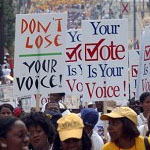
 On March 2, FairVote and California Common Cause filed an amicus
brief to defend the California Voting Rights Act and argue that
proportional voting systems are sensible remedies in such cases.
Adopted in 2001, the California Voting Rights Act showcases how states
can protect voting rights even when Congress may weaken the federal
Voting Rights Act. Among other provisions, the Act allows plaintiffs to
challenge winner-take-all, at-large election systems when racially
polarized voting exists. The Lawyers Commitee for Civil Rights filed
such a challenge in Sanchez v. City of Modesto, but a judge struck down the Act.
On March 2, FairVote and California Common Cause filed an amicus
brief to defend the California Voting Rights Act and argue that
proportional voting systems are sensible remedies in such cases.
Adopted in 2001, the California Voting Rights Act showcases how states
can protect voting rights even when Congress may weaken the federal
Voting Rights Act. Among other provisions, the Act allows plaintiffs to
challenge winner-take-all, at-large election systems when racially
polarized voting exists. The Lawyers Commitee for Civil Rights filed
such a challenge in Sanchez v. City of Modesto, but a judge struck down the Act.
FairVote and Common Cause argue that remedies like proportional voting systems can address the impact of winner-take-all, at-large voting methods. Beyond this case, FairVote urges other states to consider state Voting Rights Acts and, for those challenging winner-take-all at-large systems, to look to proportional systems as a sensible remedy.
[ Application for leave to file amicus ]
[ Brief of Amici Curiae ]
[ FairVote support for reauthorizing federal Voting Rights Act ]
[ Talking points on state Voting Rights Acts ]
[ What is proportional voting? ]
 The Democratic Party of California formally endorsed a plan aimed at
more voters having influence in the choice of their party's
presidential candidate. The American Plan, which was the only
alternaitve explicitly mentioned in the DNC's Commission on
Presidential Nomination Timing and Scheduling 2005 report, has been
steadily gathering enthusiasm in California where grassroots supporters
have been attracting attention to the plan one county committee after
another. The state party's decision to back the plan is the first state
party to take this bold step, though the Young Democrats of America
endorsed the American Plan in 2005.
The Democratic Party of California formally endorsed a plan aimed at
more voters having influence in the choice of their party's
presidential candidate. The American Plan, which was the only
alternaitve explicitly mentioned in the DNC's Commission on
Presidential Nomination Timing and Scheduling 2005 report, has been
steadily gathering enthusiasm in California where grassroots supporters
have been attracting attention to the plan one county committee after
another. The state party's decision to back the plan is the first state
party to take this bold step, though the Young Democrats of America
endorsed the American Plan in 2005. Republican and Democratic lawmakers alike are citing the need for
broad reforms, such as proportional voting, to overhaul the state's
broken electoral system. Members of the California Assembly plan to
introduce legislation in 2006 that would create a representative body
of 80 citizens from all over the state to study
election problems. The citizens would make recommendations that would either be adopted
legislatively or submitted as a ballot initiative to face voters.
Republican and Democratic lawmakers alike are citing the need for
broad reforms, such as proportional voting, to overhaul the state's
broken electoral system. Members of the California Assembly plan to
introduce legislation in 2006 that would create a representative body
of 80 citizens from all over the state to study
election problems. The citizens would make recommendations that would either be adopted
legislatively or submitted as a ballot initiative to face voters.