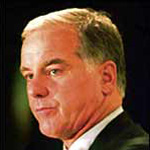
 On March 16th, Former Vermont Governor and Democratic National Committee Chair Howard Dean continued his support for instant runoff voting on Vermont Radio's Mark Johnson Show. Commenting on Burlington's recent IRV election, Dean said "I think the best and most democratic way to use to elect people in multiparty elections is instant runoff voting." Dean also supported the system when it was first used in Burlington in 2006.
 Citizens of Burlington, Vermont went to the polls on Tuesday, March 3rd to vote for the second time in an election using instant runoff voting. At 8:25 PM, the city declared that incumbent Mayor Bob Kiss had won reelection in the third and final round of counting, narrowly edging out challenger Kurt Wright, 51.5% to 48.5%. The race was unique in that it had four candidates that had a legitimate shot at winning: Progressive Kiss, Republican Wright, Democrat Andy Montroll, and independent Dan Smith. In most other American cities, there would be fear of "spoiler" candidates, but IRV allowed all four candidates to run without having to worry about being labeled "spoilers."
 On April 4, Vermont governor Jim Douglas chose to veto legislation to re-establish majority elections for Congress in his state through instant runoff voting. Vermont would have been the first state to enact IRV for Congress; legislative leaders affirmed their commitment to the bill, and it is sure to move in the state again. FairVote has worked hard to support this legislation, which likely generated more than 600 phone calls to the governor from Vermonters.
By Associated Press
Published November 1st 2005 in The Boston Globe
BRATTLEBORO, Vt. --Brattleboro could follow Burlington in instituting
instant-runoff voting, if a coalition of activist groups has its way.
The group Vermonters Restoring Democracy is mounting a petition drive asking that the idea of electing Select Board members by instant-runoff voting be considered by voters during town meeting elections in March.
Burlington will be the first Vermont community to use instant-runoff voting when residents elect a new mayor in March.
Larry Bloch, a founding member of Vermonters Restoring Democracy, said the group hopes to get other communities, and eventually state government, to adopt instant-runoff voting.
"We're encouraging other communities to push for similar reforms," Bloch said. "Hopefully that effort will be heard in Montpelier and we can go statewide."
Instant runoff voting is used when there are more than two candidates running for office and none gets more than 50 percent of the vote. Voters are asked to rank candidates in order of preference. The candidate with the fewest votes as top choice is eliminated in the first round, and his or her votes go to the voter's second choice, a process that continues until some candidate has more than 50 percent of the total vote.
Supporters of instant-runoff voting say it removes the problem of third-party candidates becoming spoilers.
More than 50 Vermont communities endorsed runoff voting at town meeting in 2002. But only Vermont towns and cities with charters can pass local laws allowing instant runoff voting to be used, according to Secretary of State Deborah Markowitz.
The group Vermonters Restoring Democracy is mounting a petition drive asking that the idea of electing Select Board members by instant-runoff voting be considered by voters during town meeting elections in March.
Burlington will be the first Vermont community to use instant-runoff voting when residents elect a new mayor in March.
Larry Bloch, a founding member of Vermonters Restoring Democracy, said the group hopes to get other communities, and eventually state government, to adopt instant-runoff voting.
"We're encouraging other communities to push for similar reforms," Bloch said. "Hopefully that effort will be heard in Montpelier and we can go statewide."
Instant runoff voting is used when there are more than two candidates running for office and none gets more than 50 percent of the vote. Voters are asked to rank candidates in order of preference. The candidate with the fewest votes as top choice is eliminated in the first round, and his or her votes go to the voter's second choice, a process that continues until some candidate has more than 50 percent of the total vote.
Supporters of instant-runoff voting say it removes the problem of third-party candidates becoming spoilers.
More than 50 Vermont communities endorsed runoff voting at town meeting in 2002. But only Vermont towns and cities with charters can pass local laws allowing instant runoff voting to be used, according to Secretary of State Deborah Markowitz.