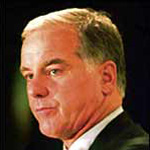
 On March 16th, Former Vermont Governor and Democratic National Committee Chair Howard Dean continued his support for instant runoff voting on Vermont Radio's Mark Johnson Show. Commenting on Burlington's recent IRV election, Dean said "I think the best and most democratic way to use to elect people in multiparty elections is instant runoff voting." Dean also supported the system when it was first used in Burlington in 2006.
 Citizens of Burlington, Vermont went to the polls on Tuesday, March 3rd to vote for the second time in an election using instant runoff voting. At 8:25 PM, the city declared that incumbent Mayor Bob Kiss had won reelection in the third and final round of counting, narrowly edging out challenger Kurt Wright, 51.5% to 48.5%. The race was unique in that it had four candidates that had a legitimate shot at winning: Progressive Kiss, Republican Wright, Democrat Andy Montroll, and independent Dan Smith. In most other American cities, there would be fear of "spoiler" candidates, but IRV allowed all four candidates to run without having to worry about being labeled "spoilers."
 On April 4, Vermont governor Jim Douglas chose to veto legislation to re-establish majority elections for Congress in his state through instant runoff voting. Vermont would have been the first state to enact IRV for Congress; legislative leaders affirmed their commitment to the bill, and it is sure to move in the state again. FairVote has worked hard to support this legislation, which likely generated more than 600 phone calls to the governor from Vermonters.
By Keri Toksu
Published May 4th 2009 in Burlington Free Press
As a member of the League of Women Voters, I've been distressed by the recent opinion pieces in the Burlington Free Press attacking instant runoff voting (IRV) in Burlington. The league is in favor of IRV, just as it supports fair voting and voting rights in general.
Unfortunately, there seems to be a basic misunderstanding of how IRV works: It simply counts the votes in each round. In the case of the most recent mayoral election in Burlington, there were three rounds. This is the same as voters going to the polls for three separate elections. Why so many rounds? Because that's how many it took for the winning candidate to achieve a majority of the vote.
In the first round of the mayoral election, Kurt Wright got 33 percent of the vote, Bob Kiss got 29 percent, Andy Montroll got 23 percent, and Dan Smith got 15 percent. Voters were pretty well spread out between Wright, Kiss and Montroll. Smith didn't do too badly either, considering he was the new kid on the block. And this describes one of the reasons the league is in favor of IRV: It supports more participation by "minor" party candidates.
Often the plea from the major parties (e.g., Democrat, Republican) to third-party candidates (e.g., Progressive, independent) and their supporters is to vote for them or be a spoiler. IRV prevents that spoiler plea. So let's say you liked independent candidate Smith best, but after that, you liked Republican candidate Wright. You got to vote your preference, and nobody was telling you that a vote for Smith was a vote for Kiss.
A particularly pernicious criticism implies that votes can be ranked. For example, that Kiss' votes didn't mean as much as Wright's votes because not as many were "first-round" votes. Does this matter? Yes, but not in the way you might think. It matters because those people who voted for Kiss in the second or third round might not have made it to the polls for the run-off election. Which is another important reason why the league supports IRV: more voter participation.
Voter turnout drops significantly in run-off elections. For example, there was a nearly 50 percent drop off in turnout in the recent Ward 7 runoff election. So although it's true that IRV saves money because another physical election doesn't need to be held, it wasn't instituted because of this admittedly positive aspect. It was instituted because it is a fair method of voting, particularly in a state where there are more than two major parties. It was also instituted because it involves the greatest number of voters in the voting process.
I regret that the league didn't conduct informational sessions on IRV during the mayoral election. It would help for people to have a place to get their questions answered. Especially when an election promises to be a close one, where at least one of the losing candidates and his or her supporters are going to be very unhappy. It's far easier to blame the election process itself rather than the number of votes received.
In fact, Vermont Public Radio did a story on IRV in February which predicted that: 1) the winner would not be the highest vote-getter in the first round; and 2) this fact would cause people to rethink IRV. They were right on both counts.
But the fact that somebody may not like who won the election is no reason to blame the election method or go backward and restore a less democratic.
Keri Toksu of Burlington is director of the Champlain Valley League of Women Voters.
Unfortunately, there seems to be a basic misunderstanding of how IRV works: It simply counts the votes in each round. In the case of the most recent mayoral election in Burlington, there were three rounds. This is the same as voters going to the polls for three separate elections. Why so many rounds? Because that's how many it took for the winning candidate to achieve a majority of the vote.
In the first round of the mayoral election, Kurt Wright got 33 percent of the vote, Bob Kiss got 29 percent, Andy Montroll got 23 percent, and Dan Smith got 15 percent. Voters were pretty well spread out between Wright, Kiss and Montroll. Smith didn't do too badly either, considering he was the new kid on the block. And this describes one of the reasons the league is in favor of IRV: It supports more participation by "minor" party candidates.
Often the plea from the major parties (e.g., Democrat, Republican) to third-party candidates (e.g., Progressive, independent) and their supporters is to vote for them or be a spoiler. IRV prevents that spoiler plea. So let's say you liked independent candidate Smith best, but after that, you liked Republican candidate Wright. You got to vote your preference, and nobody was telling you that a vote for Smith was a vote for Kiss.
A particularly pernicious criticism implies that votes can be ranked. For example, that Kiss' votes didn't mean as much as Wright's votes because not as many were "first-round" votes. Does this matter? Yes, but not in the way you might think. It matters because those people who voted for Kiss in the second or third round might not have made it to the polls for the run-off election. Which is another important reason why the league supports IRV: more voter participation.
Voter turnout drops significantly in run-off elections. For example, there was a nearly 50 percent drop off in turnout in the recent Ward 7 runoff election. So although it's true that IRV saves money because another physical election doesn't need to be held, it wasn't instituted because of this admittedly positive aspect. It was instituted because it is a fair method of voting, particularly in a state where there are more than two major parties. It was also instituted because it involves the greatest number of voters in the voting process.
I regret that the league didn't conduct informational sessions on IRV during the mayoral election. It would help for people to have a place to get their questions answered. Especially when an election promises to be a close one, where at least one of the losing candidates and his or her supporters are going to be very unhappy. It's far easier to blame the election process itself rather than the number of votes received.
In fact, Vermont Public Radio did a story on IRV in February which predicted that: 1) the winner would not be the highest vote-getter in the first round; and 2) this fact would cause people to rethink IRV. They were right on both counts.
But the fact that somebody may not like who won the election is no reason to blame the election method or go backward and restore a less democratic.
Keri Toksu of Burlington is director of the Champlain Valley League of Women Voters.