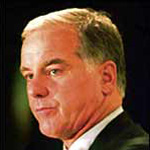
 On March 16th, Former Vermont Governor and Democratic National Committee Chair Howard Dean continued his support for instant runoff voting on Vermont Radio's Mark Johnson Show. Commenting on Burlington's recent IRV election, Dean said "I think the best and most democratic way to use to elect people in multiparty elections is instant runoff voting." Dean also supported the system when it was first used in Burlington in 2006.
 Citizens of Burlington, Vermont went to the polls on Tuesday, March 3rd to vote for the second time in an election using instant runoff voting. At 8:25 PM, the city declared that incumbent Mayor Bob Kiss had won reelection in the third and final round of counting, narrowly edging out challenger Kurt Wright, 51.5% to 48.5%. The race was unique in that it had four candidates that had a legitimate shot at winning: Progressive Kiss, Republican Wright, Democrat Andy Montroll, and independent Dan Smith. In most other American cities, there would be fear of "spoiler" candidates, but IRV allowed all four candidates to run without having to worry about being labeled "spoilers."
 On April 4, Vermont governor Jim Douglas chose to veto legislation to re-establish majority elections for Congress in his state through instant runoff voting. Vermont would have been the first state to enact IRV for Congress; legislative leaders affirmed their commitment to the bill, and it is sure to move in the state again. FairVote has worked hard to support this legislation, which likely generated more than 600 phone calls to the governor from Vermonters.
Let courts, not the City Council, rule on its constitutionality
City councils are not courts. It isn't the role of a council to settle disputes over constitutionality.
It also shouldn't be up to council members to keep charter amendments that originate via petition off the November ballot. That would defeat the purpose of allowing charter changes to spring from the people by petition, as well as from charter commissions and city councils. Designers of the petition option for city-charter changes recognized that sometimes, councils and commissions are hostile to worthy new ideas.
That's why the Better Ballot Campaign, which backs instant-runoff voting, is right to threaten legal action if the St. Paul City Council this week blocks its petition-generated charter amendment from the November ballot. They've got a worthy, albeit disputed, idea, as well as 5,386 verified signatures, nearly 300 more than required to set a charter change in motion. The council shouldn't stop it, even though six of its seven members have indicated their opposition.
The state Supreme Court has long held that only when a proposed amendment is "manifestly unconstitutional" can a city council stand between petitioners and the ballot. That much certainty cannot be claimed about the constitutional impermissibility of IRV.
St. Paul city attorney John Choi has advised the council that he does not believe IRV will win that court test. But the Better Ballot group makes potent arguments to the contrary, with the help of legal talent including former City Council Member Jay Benanav.
A number of municipal governments around the country -- San Francisco; Cambridge, Mass., and Burlington, Vt., among them -- are using IRV, and have survived court tests. A court challenge is also pending in Minneapolis, where voters embraced IRV in 2006 for future city elections.
That case is likely to wind up at the state Supreme Court, probably next year. That's the rightful venue -- not the City Council -- for determining whether Minnesota cities are free under the state Constitution to adopt a new voting method in municipal elections.
If IRV is ruled unconstitutional by the high court, that won't be the end of the story. The list of IRV fans is growing as its advantages come into focus. IRV promises Minnesotans that they can indulge their third-party impulses without sacrificing majority rule. They can eliminate low-turnout primaries in nonpartisan elections, which would give more opportunity to challengers. (That's why some incumbents resist IRV.) They can look forward to less negative campaigns, as candidates seek to maximize their second-choice votes.
A negative ruling by the high court would only move the IRV fight to the Legislature, where constitutional amendments originate. In that venue, a vote on IRV in St. Paul this fall, no matter its outcome, will carry considerable weight. The City Council should let the vote proceed.