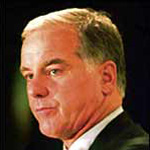
 On March 16th, Former Vermont Governor and Democratic National Committee Chair Howard Dean continued his support for instant runoff voting on Vermont Radio's Mark Johnson Show. Commenting on Burlington's recent IRV election, Dean said "I think the best and most democratic way to use to elect people in multiparty elections is instant runoff voting." Dean also supported the system when it was first used in Burlington in 2006.
 Citizens of Burlington, Vermont went to the polls on Tuesday, March 3rd to vote for the second time in an election using instant runoff voting. At 8:25 PM, the city declared that incumbent Mayor Bob Kiss had won reelection in the third and final round of counting, narrowly edging out challenger Kurt Wright, 51.5% to 48.5%. The race was unique in that it had four candidates that had a legitimate shot at winning: Progressive Kiss, Republican Wright, Democrat Andy Montroll, and independent Dan Smith. In most other American cities, there would be fear of "spoiler" candidates, but IRV allowed all four candidates to run without having to worry about being labeled "spoilers."
 On April 4, Vermont governor Jim Douglas chose to veto legislation to re-establish majority elections for Congress in his state through instant runoff voting. Vermont would have been the first state to enact IRV for Congress; legislative leaders affirmed their commitment to the bill, and it is sure to move in the state again. FairVote has worked hard to support this legislation, which likely generated more than 600 phone calls to the governor from Vermonters.
Bill would implement new voting method for congressional races
By Vermont League of Women Voters
Published April 26th 2007
MONTPELIER, VT - By a vote of 16 to 12, the Vermont State Senate today approved a bill to implement a new voting method, instant runoff voting (IRV). IRV will only be used in U.S. House and U.S. Senate races. In 2008, IRV would only apply to the House race.
IRV is a majority voting system that does everything a traditional runoff system does to ensure the winner of an election has popular support � but in 1 election rather than 2. IRV combines the 1st and 2nd rounds of a runoff into one efficient election by enabling voters to rank candidates in order of preference. If there is no majority winner, then an instant runoff will be conducted. Only the top two vote getters will advance. The instant runoff will be conducted at regional voting centers, supervised by the Secretary of State, in consultation with town clerks and boards of civil authority.
The benefits of IRV include:
- Elects majority winners, which protects democracy and reflects the values of Vermont�s constitutional framers
- Keeps �spoiler candidates� from undercutting the principle of majority rule.
- Rewards candidates who focus on issues
- Compared to traditional runoffs, saves taxpayer dollars used to hold two polling days, avoids low turnout runoff elections, and eases the burdens on election officials
IRV is easy for voters. They can mark their ballots just as they always have in the past and can choose to pick only one candidate or rank up to 5. If no candidate wins a majority of first choices, the top 2 candidates advance to an instant runoff. If a voter�s first choice is eliminated, the ballot is counted for that voter�s next top choice. Ranking alternate candidates is easy. In their 1st IRV mayoral election, 99.9% of Burlington voters cast a valid ballot. IRV was well understood across all demographic groups.
According to Catherine Rader of the Vermont League of Women Voters, "People want high-turnout, spoiler-free elections where the majority wins. Interest in instant runoff voting is growing rapidly." IRV is a majority voting system that does everything a traditional runoff system does to ensure the winner of an election has popular support � but in 1 election rather than 2. IRV combines the 1st and 2nd rounds of a runoff into one efficient election by enabling voters to rank candidates in order of preference.
IRV has become a popular election reform around the country in recent years. It is used for local elections in San Francisco and Burlington (VT) and for overseas military voters in South Carolina, Arkansas and Louisiana. Minneapolis, Oakland and a number of cities and counties in North Carolina are all in the process of implementing IRV for use in the next few years.
Eyes now turn to the Vermont House, as well as to Governor Jim Douglas who, in 2005, signed into law an act to amend the town charter of Burlington to allow the town to use IRV to elect local leaders.