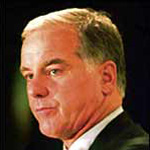
 On March 16th, Former Vermont Governor and Democratic National Committee Chair Howard Dean continued his support for instant runoff voting on Vermont Radio's Mark Johnson Show. Commenting on Burlington's recent IRV election, Dean said "I think the best and most democratic way to use to elect people in multiparty elections is instant runoff voting." Dean also supported the system when it was first used in Burlington in 2006.
 Citizens of Burlington, Vermont went to the polls on Tuesday, March 3rd to vote for the second time in an election using instant runoff voting. At 8:25 PM, the city declared that incumbent Mayor Bob Kiss had won reelection in the third and final round of counting, narrowly edging out challenger Kurt Wright, 51.5% to 48.5%. The race was unique in that it had four candidates that had a legitimate shot at winning: Progressive Kiss, Republican Wright, Democrat Andy Montroll, and independent Dan Smith. In most other American cities, there would be fear of "spoiler" candidates, but IRV allowed all four candidates to run without having to worry about being labeled "spoilers."
 On April 4, Vermont governor Jim Douglas chose to veto legislation to re-establish majority elections for Congress in his state through instant runoff voting. Vermont would have been the first state to enact IRV for Congress; legislative leaders affirmed their commitment to the bill, and it is sure to move in the state again. FairVote has worked hard to support this legislation, which likely generated more than 600 phone calls to the governor from Vermonters.
By Terri Hallenbeck
Published April 13th 2007 in Burlington Free Press
MONTPELIER -- Legislators are pushing to pass a bill that would implement instant runoff voting in next year's U.S. House race.
A Senate committee is poised to vote out the legislation today that -- if it makes it through the full process -- would make Vermont the first state in the country to employ the voting method in a statewide race. Instant runoff voting, in which voters rank their choice of candidates, was used last year in the Burlington mayoral race.
The legislation calls for using instant runoff voting, or IRV, for Vermont's U.S. House and U.S. Senate races starting in 2008. Because there is no Senate election in Vermont until 2010, it would involve only the House race next year.
Lawmakers are far from unanimous on the issue, a fact that was apparent Thursday in the Senate Government Operations Committee.
"I say let's do it," said Sen. Edward Flanagan, D-Chittenden.
"We're adding a system to a system that already works," objected Sen. William Doyle, R-Washington.
"I don't want to foot-drag it anymore. I think it's time to get it out of committee and have the debate on the floor," said Sen. Claire Ayer, D-Addison.
The committee is expected to do that today.
Under the legislation, voters would rank their choices for the U.S. House, just as Burlington voters did in the 2006 mayoral election. If no candidate received more than 50 percent of the votes, the two candidates with the greatest number of first choice votes would advance. The second choice of voters who did not choose one of the top two candidates would then be added to the tally, a process that would continue through the rankings until a candidate had more than 50 percent of the vote.
The state would not use computer software to compute the runoff. It took just minutes to figure the second choices into the 2006 Burlington mayoral race with the computer. No software is available that would work on a statewide basis. The state would instead pack up and seal all the votes, ship them to points around the state, and conduct the runoff with a hand count.
Secretary of State Deborah Markowitz said it would take a couple of weeks to gather the votes and conduct the recount.
Markowitz said she supports instant runoff voting because it means the winning candidate has the backing of a majority of the voters. When a candidate is elected by less than a majority, voters become cynical, she said.
"My stand philosophically is that majority elections are a good thing for democracy," Markowitz said.
To start with the federal races makes sense, she said, because there is a high level of voter interest in those seats. To use the new system in all races would be expensive and logistically challenging, she said.
Markowitz estimated making the change would cost from $45,000 to $370,000 extra, depending on the length of the ballot and the number of runoff counts required. It would cost another $60,000 to increase voter education to explain the process the first year of its use, she said.
Alison Kaiser, the Stowe town clerk who represents the Vermont Municipal Clerks and Treasurers Association, said clerks worry that the system would create longer ballots and higher costs for the municipalities.
If the Senate Government Operations Committee votes the bill out today, it would likely go before the full Senate next week. If it passes there, the House Government Operations Committee stands ready to take it up, said Chairwoman Donna Sweaney, D-Windsor.
House Speaker Gaye Symington, D-Jericho, said she supports instant runoff voting and has encouraged the committee to work on it, though she said time is running out on the session.
Gov. Jim Douglas said he opposes IRV over cost, confusion and philosophy. "I think elections ought to be actual contests, not hypothetical ones," he said.
Rep. Peter Welch, D-Vt., whose seat would be most affected if the legislation passes, supports the concept of IRV, spokesman Andrew Savage said.
Contact Terri Hallenbeck at 229-4126 or [email protected]