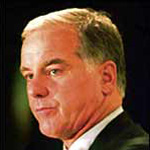
 On March 16th, Former Vermont Governor and Democratic National Committee Chair Howard Dean continued his support for instant runoff voting on Vermont Radio's Mark Johnson Show. Commenting on Burlington's recent IRV election, Dean said "I think the best and most democratic way to use to elect people in multiparty elections is instant runoff voting." Dean also supported the system when it was first used in Burlington in 2006.
 Citizens of Burlington, Vermont went to the polls on Tuesday, March 3rd to vote for the second time in an election using instant runoff voting. At 8:25 PM, the city declared that incumbent Mayor Bob Kiss had won reelection in the third and final round of counting, narrowly edging out challenger Kurt Wright, 51.5% to 48.5%. The race was unique in that it had four candidates that had a legitimate shot at winning: Progressive Kiss, Republican Wright, Democrat Andy Montroll, and independent Dan Smith. In most other American cities, there would be fear of "spoiler" candidates, but IRV allowed all four candidates to run without having to worry about being labeled "spoilers."
 On April 4, Vermont governor Jim Douglas chose to veto legislation to re-establish majority elections for Congress in his state through instant runoff voting. Vermont would have been the first state to enact IRV for Congress; legislative leaders affirmed their commitment to the bill, and it is sure to move in the state again. FairVote has worked hard to support this legislation, which likely generated more than 600 phone calls to the governor from Vermonters.
 Better elections with instant runoffs
By Ryan O'Donnell
Published April 2nd 2007 in The Boston Globe
With our current electoral laws, filling the vacancy created by Martin Meehan's departure from the House of Representatives might be as pleasant for voters as filling a cavity.
In the days after his announcement of taking over the chancellorship of his alma mater, the University of Massachusetts at Lowell, the crush of candidates salivating at the chance to replace him was already huge. Numerous state legislators, the mayor of Lawrence, the former mayor of Lowell, the widow of a former US senator, and probably each of their mothers were among the many said to be eyeing the race.
This avalanche of political ambition was predictable. Congressional seats don't open up very often, and the winners generally hold on to them for life. These prized political positions could become even harder to come by after the 2010 Census, which will probably translate the stagnant population of Massachusetts into less representation in Congress.
But if history is any guide, the result in the special election for Meehan's seat will not be pretty. Two not-so-distant elections spring to mind: Stephen Lynch won the 2001 Democratic primary to replace Joe Moakley, the late representative, with 39 percent of the vote, while the 1998 race in the Eighth District saw Michael Capuano win the Democratic primary with 23 percent of the votes cast.
In the current case, too, because of the sheer quantity of candidates, someone could win the Democratic primary with a low percentage of the vote. With a large field, it's conceivable that as many as 70 percent of primary voters could cast ballots for someone other than the winner. If turnout is low, the number of people who cast a meaningful vote is even lower. That just isn't good for democracy.
There are a couple of ways to prevent mass fragmentation of the vote. The first would be to limit the number of candidates, but that is as anti democratic as a non majority winner. The second would be to hold a runoff between the top two voter getters, but that would cost a pretty penny and see even worse turnout in the second round.
The best way is to fill the vacancy, and all future vacancies, using a method that is increasingly popular all over the country. Instant-runoff voting, adopted in cities from Burlington, Vt., to Minneapolis to San Francisco, allows voters to rank their candidates in order of choice. If one candidate gets a majority of first choices, the race is over. If not, the lowest vote-getter is knocked off, and ballots cast for that candidate are added to the totals of the candidate ranked next on each ballot. The process repeats until a majority winner emerges. Just like a traditional runoff.
More and more, this method of voting is looking like what we should have been using all along in our country. It achieves majority winners, encourages turnout, and prevents the infamous "spoiler" problem we all saw in Florida in 2000. It also saves millions of dollars as a replacement for traditional runoffs. North Carolina passed legislation last year to use instant-runoff voting for certain judicial office vacancies and to conduct a pilot program in up to 10 cities this fall.
Let's face it. The way Massachusetts (and most of the country) works, voters are going to be married to the winner of the special election for years to come. That being the case, lawmakers should fill the vacancy with a method that ensures that the next member of Congress from the Fifth District has the broadest support possible.
Ryan O'Donnell is communications director for FairVote.
In the days after his announcement of taking over the chancellorship of his alma mater, the University of Massachusetts at Lowell, the crush of candidates salivating at the chance to replace him was already huge. Numerous state legislators, the mayor of Lawrence, the former mayor of Lowell, the widow of a former US senator, and probably each of their mothers were among the many said to be eyeing the race.
This avalanche of political ambition was predictable. Congressional seats don't open up very often, and the winners generally hold on to them for life. These prized political positions could become even harder to come by after the 2010 Census, which will probably translate the stagnant population of Massachusetts into less representation in Congress.
But if history is any guide, the result in the special election for Meehan's seat will not be pretty. Two not-so-distant elections spring to mind: Stephen Lynch won the 2001 Democratic primary to replace Joe Moakley, the late representative, with 39 percent of the vote, while the 1998 race in the Eighth District saw Michael Capuano win the Democratic primary with 23 percent of the votes cast.
In the current case, too, because of the sheer quantity of candidates, someone could win the Democratic primary with a low percentage of the vote. With a large field, it's conceivable that as many as 70 percent of primary voters could cast ballots for someone other than the winner. If turnout is low, the number of people who cast a meaningful vote is even lower. That just isn't good for democracy.
There are a couple of ways to prevent mass fragmentation of the vote. The first would be to limit the number of candidates, but that is as anti democratic as a non majority winner. The second would be to hold a runoff between the top two voter getters, but that would cost a pretty penny and see even worse turnout in the second round.
The best way is to fill the vacancy, and all future vacancies, using a method that is increasingly popular all over the country. Instant-runoff voting, adopted in cities from Burlington, Vt., to Minneapolis to San Francisco, allows voters to rank their candidates in order of choice. If one candidate gets a majority of first choices, the race is over. If not, the lowest vote-getter is knocked off, and ballots cast for that candidate are added to the totals of the candidate ranked next on each ballot. The process repeats until a majority winner emerges. Just like a traditional runoff.
More and more, this method of voting is looking like what we should have been using all along in our country. It achieves majority winners, encourages turnout, and prevents the infamous "spoiler" problem we all saw in Florida in 2000. It also saves millions of dollars as a replacement for traditional runoffs. North Carolina passed legislation last year to use instant-runoff voting for certain judicial office vacancies and to conduct a pilot program in up to 10 cities this fall.
Let's face it. The way Massachusetts (and most of the country) works, voters are going to be married to the winner of the special election for years to come. That being the case, lawmakers should fill the vacancy with a method that ensures that the next member of Congress from the Fifth District has the broadest support possible.
Ryan O'Donnell is communications director for FairVote.