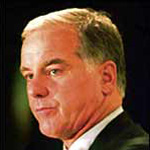
 On March 16th, Former Vermont Governor and Democratic National Committee Chair Howard Dean continued his support for instant runoff voting on Vermont Radio's Mark Johnson Show. Commenting on Burlington's recent IRV election, Dean said "I think the best and most democratic way to use to elect people in multiparty elections is instant runoff voting." Dean also supported the system when it was first used in Burlington in 2006.
 Citizens of Burlington, Vermont went to the polls on Tuesday, March 3rd to vote for the second time in an election using instant runoff voting. At 8:25 PM, the city declared that incumbent Mayor Bob Kiss had won reelection in the third and final round of counting, narrowly edging out challenger Kurt Wright, 51.5% to 48.5%. The race was unique in that it had four candidates that had a legitimate shot at winning: Progressive Kiss, Republican Wright, Democrat Andy Montroll, and independent Dan Smith. In most other American cities, there would be fear of "spoiler" candidates, but IRV allowed all four candidates to run without having to worry about being labeled "spoilers."
 On April 4, Vermont governor Jim Douglas chose to veto legislation to re-establish majority elections for Congress in his state through instant runoff voting. Vermont would have been the first state to enact IRV for Congress; legislative leaders affirmed their commitment to the bill, and it is sure to move in the state again. FairVote has worked hard to support this legislation, which likely generated more than 600 phone calls to the governor from Vermonters.
By Steven Hill
Published November 27th 2006 in California Progress Report
Instant Runoff Voting (IRV), an idea advanced by the New America Foundation, a California and Washington DC-based think tank, and by FairVote, a national nonprofit, to give voters more influence and more choices in elections, continued to gain favor in California and elsewhere as four cities strongly approved Nov. 7 ballot measures supporting the idea, the foundation says.
In California, where San Francisco became the state's first Instant Runoff Voting city in 2004, voters in the cities of Oakland and Davis approved the idea, which would allow voters to rank their first, second, and third choices for office. Oakland overwhelmingly supported the measure by 69 percent of the returns, meaning voters will use Instant Runoff Voting for all local offices in November 2008. The Davis measure was an advisory recommendation.
Elsewhere, voters in Minneapolis passed their ballot measure with 65 percent support. And in Pierce County, Washington, voters supported the move to IRV for their partisan county elections with 54 percent of the vote.
New America staff Lynne Serpe and I played a key role as advisers to several of these campaigns. New America joined other organizations in these efforts, including FairVote, a nonprofit, nonpartisan educational organization that is the national clearinghouse on electoral systems like instant runoff voting.
The elections clearly affirm a growing trend toward Instant Runoff Voting as a response to public frustration with unresponsive and unaccountable government leaders. Instant Runoff Voting discourages negative campaigning and opens the process to candidates and ideas that may not be viable in a traditional winner-take-all election.
"Clearly there is strong interest among voters in political reforms that open up the political system and make voters feel like their vote counts," said Lynne Serpe, deputy director of New America's Political Reform Program. "What was interesting about the four victories for IRV was that they happened in four very different locations. Oakland is a very diverse and working-class city; Minneapolis is a Midwestern values city; Pierce County is a mix of rural, suburban and urban areas with many independent minded voters; and Davis is a smaller, university town. Yet in every place Instant Runoff Voting provided a unique solution to problems with representative government and democracy."
Instant Runoff Voting already is used in San Francisco, which on Nov. 7 had its third election using Instant Runoff Voting for local offices. Burlington, Vermont elected its mayor using Instant Runoff Voting in March.
Steven Hill is the Director of the Political Reform Program of the New America Foundation and author of the recently published "Ten Steps to Repair American Democracy" (PoliPoint Press, May 2006, www.10steps.net).
For more information, visit the websites of New America�s political reform program, and FairVote.