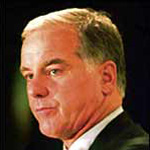
 On March 16th, Former Vermont Governor and Democratic National Committee Chair Howard Dean continued his support for instant runoff voting on Vermont Radio's Mark Johnson Show. Commenting on Burlington's recent IRV election, Dean said "I think the best and most democratic way to use to elect people in multiparty elections is instant runoff voting." Dean also supported the system when it was first used in Burlington in 2006.
 Citizens of Burlington, Vermont went to the polls on Tuesday, March 3rd to vote for the second time in an election using instant runoff voting. At 8:25 PM, the city declared that incumbent Mayor Bob Kiss had won reelection in the third and final round of counting, narrowly edging out challenger Kurt Wright, 51.5% to 48.5%. The race was unique in that it had four candidates that had a legitimate shot at winning: Progressive Kiss, Republican Wright, Democrat Andy Montroll, and independent Dan Smith. In most other American cities, there would be fear of "spoiler" candidates, but IRV allowed all four candidates to run without having to worry about being labeled "spoilers."
 On April 4, Vermont governor Jim Douglas chose to veto legislation to re-establish majority elections for Congress in his state through instant runoff voting. Vermont would have been the first state to enact IRV for Congress; legislative leaders affirmed their commitment to the bill, and it is sure to move in the state again. FairVote has worked hard to support this legislation, which likely generated more than 600 phone calls to the governor from Vermonters.
 Lawmakers may order study of statewide instant runoff voting
By Ross Sneyd
Published March 15th 2006 in Associated Press
MONTPELIER, Vt. --Instant runoff voting was rated a success Wednesday
by most who worked with the new system of electing Burlington's mayor
last week, but a key legislator said it probably still would not be
adopted statewide just yet.
Instead, legislators believe they'll probably order a commission to study the more complex issues of using the system throughout the state, with its more than 251 towns and voting precincts.
"We want to take it carefully because we're talking about a statewide election," said Senate Government Operations Committee Chairman James Condos, D-Chittenden.
Condos' committee and its House counterpart took testimony from Burlington officials a little more than a week after the city used an instant runoff when none of the five candidates for mayor won 50 percent of the vote. Voters had been given the opportunity to rank their second, third and fourth choices and Progressive Bob Kiss won on the second round.
Kiss, currently a state representative, said he believed the system had been a success, both in the way it was administered and the way it affected the election. But his unsuccessful Democratic opponent, state Sen. Hinda Miller, did not.
Miller said it skewed the campaign and put the Republican candidate, City Councilor Kevin Curley, in the position of affecting the outcome by endorsing Kiss as the best second choice.
"As a candidate you're forced to figure out or your supporters are forced to figure out how to game the system," she said. "It was the Kevin Curley second vote that decided the election. he was the candidate who interfered, in my mind, with the independent thinking of his voters."
She and fellow Democrat Sandra Baird said the runoff system ended up forcing candidates to blur their differences so they might win a voter's second choice. "Because they were all vying for each other's second-place votes, they were trying to please each other," Baird said. "I'm interested in the distinction between them on the issues and that wasn't clear."
Kiss, asked to respond directly by a member of the committee, took a different view. He pointed out that there had been a difference among the candidates on whether Burlington voters should favor being able to institute a local sales tax. There also were differences on the tax increase necessary to support the schools' budget.
"I think there were distinctions in the debate," he said. "I think it encourages people to look more broadly at the debate."
Instead, legislators believe they'll probably order a commission to study the more complex issues of using the system throughout the state, with its more than 251 towns and voting precincts.
"We want to take it carefully because we're talking about a statewide election," said Senate Government Operations Committee Chairman James Condos, D-Chittenden.
Condos' committee and its House counterpart took testimony from Burlington officials a little more than a week after the city used an instant runoff when none of the five candidates for mayor won 50 percent of the vote. Voters had been given the opportunity to rank their second, third and fourth choices and Progressive Bob Kiss won on the second round.
Kiss, currently a state representative, said he believed the system had been a success, both in the way it was administered and the way it affected the election. But his unsuccessful Democratic opponent, state Sen. Hinda Miller, did not.
Miller said it skewed the campaign and put the Republican candidate, City Councilor Kevin Curley, in the position of affecting the outcome by endorsing Kiss as the best second choice.
"As a candidate you're forced to figure out or your supporters are forced to figure out how to game the system," she said. "It was the Kevin Curley second vote that decided the election. he was the candidate who interfered, in my mind, with the independent thinking of his voters."
She and fellow Democrat Sandra Baird said the runoff system ended up forcing candidates to blur their differences so they might win a voter's second choice. "Because they were all vying for each other's second-place votes, they were trying to please each other," Baird said. "I'm interested in the distinction between them on the issues and that wasn't clear."
Kiss, asked to respond directly by a member of the committee, took a different view. He pointed out that there had been a difference among the candidates on whether Burlington voters should favor being able to institute a local sales tax. There also were differences on the tax increase necessary to support the schools' budget.
"I think there were distinctions in the debate," he said. "I think it encourages people to look more broadly at the debate."