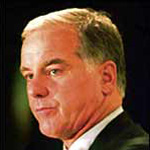
 On March 16th, Former Vermont Governor and Democratic National Committee Chair Howard Dean continued his support for instant runoff voting on Vermont Radio's Mark Johnson Show. Commenting on Burlington's recent IRV election, Dean said "I think the best and most democratic way to use to elect people in multiparty elections is instant runoff voting." Dean also supported the system when it was first used in Burlington in 2006.
 Citizens of Burlington, Vermont went to the polls on Tuesday, March 3rd to vote for the second time in an election using instant runoff voting. At 8:25 PM, the city declared that incumbent Mayor Bob Kiss had won reelection in the third and final round of counting, narrowly edging out challenger Kurt Wright, 51.5% to 48.5%. The race was unique in that it had four candidates that had a legitimate shot at winning: Progressive Kiss, Republican Wright, Democrat Andy Montroll, and independent Dan Smith. In most other American cities, there would be fear of "spoiler" candidates, but IRV allowed all four candidates to run without having to worry about being labeled "spoilers."
 On April 4, Vermont governor Jim Douglas chose to veto legislation to re-establish majority elections for Congress in his state through instant runoff voting. Vermont would have been the first state to enact IRV for Congress; legislative leaders affirmed their commitment to the bill, and it is sure to move in the state again. FairVote has worked hard to support this legislation, which likely generated more than 600 phone calls to the governor from Vermonters.
Instant Runoff Voting
By Ken Picard
Published March 15th 2006 in Seven Days
BURLINGTON -- The 2006 mayoral election, which featured Vermont's
first-ever use of Instant Runoff Voting (IRV), wasn't just a local
milestone. It's also being hailed as a successful model for electoral
reform for other municipalities and states across the country,
according to one expert who helped the city with its implementation.
Caleb Kleppner is a consultant with Election Solutions of New Haven, Connecticut. In December, Kleppner began working with the City of Burlington to design an IRV voter-education campaign and test the software that would tally the results.
"The real story of this election is that it worked incredibly smoothly, more smoothly than I expected," Klepper says. "Voters and poll workers didn't have any problems with it at all."
IRV balloting allows voters to rank their choice of candidates in order of preference. Although critics warned that certain people, such as first-time voters and the elderly, might get confused by the new system, nearly all Burlington voters found the transition an easy one; the city's help desk was quiet all day.
The process of closing down the polling stations at the end of the night was also quick and hassle-free, according to Kleppner. The polls closed at 7 and, by 8:30, election officials were already announcing the ward-level results. By 9 p.m., the mayoral returns were made public. "Poll workers, voters and the media all came to the same conclusion: 'This was easy,'" Kleppner adds.
Burlington's mayoral election was also noteworthy for its unprecedented openness. Anyone with access to an online computer can visit a website -- www.burlingtonvotes.org -- to see the electronic record of every vote cast, and examine the software used to count it. Those who question the outcome of the election can also download the raw data and the software and independently tally the votes, then check those results against the paper ballots kept in City Hall. The only information that's not public is the identity of each voter and the proprietary software of Diebold, the manufacturer of Burlington's ballot-scanning machines.
"This is the most transparent election that's ever been conducted in the United States," Kleppner asserts. "You've got an electronic record of every vote, you've got a paper record of every vote, and any member of the public can scrutinize it."
Burlington is only the second city in the nation to use IRV balloting on modern voting equipment -- San Francisco was the first, in 2004. However, IRV is not a new phenomenon in the United States. According to Kleppner, it was first used in municipal elections as early as the 1910s and was a common practice around the country throughout much of the first half of the 20th century.
The advantages of IRV are obvious. Since it eliminates the need for traditional runoff elections, it saves candidates and election officials both time and money. And, the results of IRV are seen as more representative of the will of the people, since voter turnout usually drops considerably in a runoff race.
However, IRV was discontinued for both practical and political reasons. Before the advent of electronic voting machines, IRV ballots could be very time-consuming to tally by hand; in other places, the losing party lobbied for their removal. For instance, Ann Arbor, Michigan, decided its 1975 mayoral race by IRV, only to discontinue it shortly afterwards, when the Republican frontrunner, who had earned 49 percent of the vote in the first round, lost to the Democratic candidate, who had garnered only 40 percent.
Kleppner predicts that Burlington's overwhelming success with IRV will encourage other towns and cities to consider adopting it. "There's growing interest in IRV across the country," he suggests, "but a lot of places didn't want to be the first ones to stick their necks out."
Caleb Kleppner is a consultant with Election Solutions of New Haven, Connecticut. In December, Kleppner began working with the City of Burlington to design an IRV voter-education campaign and test the software that would tally the results.
"The real story of this election is that it worked incredibly smoothly, more smoothly than I expected," Klepper says. "Voters and poll workers didn't have any problems with it at all."
IRV balloting allows voters to rank their choice of candidates in order of preference. Although critics warned that certain people, such as first-time voters and the elderly, might get confused by the new system, nearly all Burlington voters found the transition an easy one; the city's help desk was quiet all day.
The process of closing down the polling stations at the end of the night was also quick and hassle-free, according to Kleppner. The polls closed at 7 and, by 8:30, election officials were already announcing the ward-level results. By 9 p.m., the mayoral returns were made public. "Poll workers, voters and the media all came to the same conclusion: 'This was easy,'" Kleppner adds.
Burlington's mayoral election was also noteworthy for its unprecedented openness. Anyone with access to an online computer can visit a website -- www.burlingtonvotes.org -- to see the electronic record of every vote cast, and examine the software used to count it. Those who question the outcome of the election can also download the raw data and the software and independently tally the votes, then check those results against the paper ballots kept in City Hall. The only information that's not public is the identity of each voter and the proprietary software of Diebold, the manufacturer of Burlington's ballot-scanning machines.
"This is the most transparent election that's ever been conducted in the United States," Kleppner asserts. "You've got an electronic record of every vote, you've got a paper record of every vote, and any member of the public can scrutinize it."
Burlington is only the second city in the nation to use IRV balloting on modern voting equipment -- San Francisco was the first, in 2004. However, IRV is not a new phenomenon in the United States. According to Kleppner, it was first used in municipal elections as early as the 1910s and was a common practice around the country throughout much of the first half of the 20th century.
The advantages of IRV are obvious. Since it eliminates the need for traditional runoff elections, it saves candidates and election officials both time and money. And, the results of IRV are seen as more representative of the will of the people, since voter turnout usually drops considerably in a runoff race.
However, IRV was discontinued for both practical and political reasons. Before the advent of electronic voting machines, IRV ballots could be very time-consuming to tally by hand; in other places, the losing party lobbied for their removal. For instance, Ann Arbor, Michigan, decided its 1975 mayoral race by IRV, only to discontinue it shortly afterwards, when the Republican frontrunner, who had earned 49 percent of the vote in the first round, lost to the Democratic candidate, who had garnered only 40 percent.
Kleppner predicts that Burlington's overwhelming success with IRV will encourage other towns and cities to consider adopting it. "There's growing interest in IRV across the country," he suggests, "but a lot of places didn't want to be the first ones to stick their necks out."