
San Francisco's third city-wide round of elections under instant runoff voting were a success. Multiple instant runoffs yielded majority winners in two hotly contested District Supervisor races. Exit polls in one District showed a high percentage of voters cast multiple rankings, with low voter error.
66% of Asian-American voters in District 4 found IRV "helpful," partly because it guaranteed that majority-Asian American district could elect a candidate of choice. The support of Asian American voters was divided among four Asian American candidates in the first round of counting. It nearly was the first IRV election in San Francsico where the first-choice leader did not win in the end; a non-Asian candidate finished a very close second in the first choice count. Such reversals don't happen very often, but when they do, it means a plurality winner would have triumphed over a fractured majority without IRV.
[Article on the District 4 race]
[Candidates accept instant runoff results in District 4]
[More on instant runoff voting]
[More on IRV in San Francisco, including the exit poll]
 The
Public Research Institute of San Francisco State University this month
released a comprehensive analysis of exit polls during San Francisco's
first citywide instant runoff election in 2005. Voters were three times
more likely to say voting with instant runoff voting (IRV) was easy than it was difficult, and
preferred IRV over the old two-round runoff system by a margin of three
to one -- support that extended to every group of voters as defined by
party, race, gender, age and neighborhood. Other analyses have shown
almost no voter error and much higher turnout than would have taken place with the
old runoff system.
The
Public Research Institute of San Francisco State University this month
released a comprehensive analysis of exit polls during San Francisco's
first citywide instant runoff election in 2005. Voters were three times
more likely to say voting with instant runoff voting (IRV) was easy than it was difficult, and
preferred IRV over the old two-round runoff system by a margin of three
to one -- support that extended to every group of voters as defined by
party, race, gender, age and neighborhood. Other analyses have shown
almost no voter error and much higher turnout than would have taken place with the
old runoff system.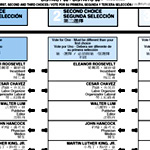 An exit poll commissioned by the City and carried out by the Public
Research Institute at San Francisco State University indicates that a
large majority understands and prefers the newly-instituted IRV
election system. Some key figures:
An exit poll commissioned by the City and carried out by the Public
Research Institute at San Francisco State University indicates that a
large majority understands and prefers the newly-instituted IRV
election system. Some key figures: