












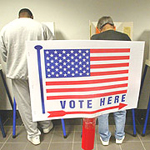
 From Maryland to Hawaii, legislatures across the country are taking up legislation to improve our patchwork system of voter registration. Six states (AZ, CA, MI, RI, WA, MD) have introduced legislation that would set a uniform advance voter registration age of 16-years-old. This policy would allow high schools to conduct effective registration drives and educate students about the mechanics of participation. Hawaii has introduced a universal voter registration bill that would ensure anyone who does not want to register affirmatively opts-out and California is considering legislation that would automatically register citizens when applying for a driver's license or filing their state income taxes. New Jersey lawmakers have introduced a bill that changes "motor voter" to an opt-out system, as opposed to the current "opt-in" regime. Connecticut, New Jersey and New York have legislation before them that would expand voter registration opportunities for high school and college students.
[FairVote's 100% Registration Project]
[Rhode Island's Advance Voter Registration Bill]
[Hawaii's Universal Voter Registration Bill]
[California's Automatic Voter Registration Bill]
[New Jersey's Opt-Out Voter Registration Bill]
[New Jersey's High School Voter Registration Bill]
 David Segal, a FairVote analyst and Rhode Island legislator, has a
commentary (a "must read" according to Rick Hasen in his
election law blog) in the New York Times focused on the importance
of electing U.S. Senate vacancies rather than allowing gubernatorial
appointments. FairVote pursued a special project on this proposal in
2007, issuing a short report and publishing a commentary. Events since
have underscored the value of having U.S. Senators have the same kind of
accountability to voters that every U.S. House Member has always
had. The same day, Sen. Russ
Feingold, Chairman of the Senate Judiciary Subcommittee on the
Constitution, announced that he would be introducing a constitutional
amendment to require election of vacancies.
David Segal, a FairVote analyst and Rhode Island legislator, has a
commentary (a "must read" according to Rick Hasen in his
election law blog) in the New York Times focused on the importance
of electing U.S. Senate vacancies rather than allowing gubernatorial
appointments. FairVote pursued a special project on this proposal in
2007, issuing a short report and publishing a commentary. Events since
have underscored the value of having U.S. Senators have the same kind of
accountability to voters that every U.S. House Member has always
had. The same day, Sen. Russ
Feingold, Chairman of the Senate Judiciary Subcommittee on the
Constitution, announced that he would be introducing a constitutional
amendment to require election of vacancies.